AN ECOLOGY OF LINE
2025
This exhibition is lovingly dedicated to the memory of
Sylvan Quinn Marion Brill
Thursday, January 9th, 2014 - Wednesday, October 29th, 2025
“every thing is a parliament of lines”
Ingold (2016: 5)
It was an interest in writing that first started me thinking about how lines are made. The mark-made line links writing to drawing; the spoken line links sound to song. An interest in mark-making set me writing into every apple on a tree. An interest in the spoken line, led me back to the sounding, moving body. And on, to the relationship between bodies, to the line as performance instruction (score) and line as trace of performance, evidence of an event that has taken place.
This interest in the wobbly event of the line, how it is made and what its making conveys, led me to develop the intra-disciplinary, creative-critical enquiry that moves “TOWARDS AN EXPERIMENTAL ECOLOGY OF LINE”. Using Tim Ingold’s taxonomy of line as a backbone, this show explores different “species” of line - threads (3D line), traces (2D line), dots (the broken line) & invisible or imaginary lines - and how these different linear modes intra-act to form an experimental ecology of line.
I am delighted that many who joined me on my initial journey, “Towards an Experimental Ecology Of Line” in 2024 have returned for more in 2025, as part of an advanced group, to explore how the categories explored in the first iteration combine and complexify their interaction in correspondence, disturbed surfaces and scores.
Peeter Torop described human culture as an “infinite process of total translation” (2003: 271), but an ecology of line extends this thinking far beyond the realm of human culture to suggest that the world is a process of infinite translation. Ingold acknowledges this transformative process in his description of the relationship between threads and traces: “on closer inspection, threads and traces appeared to be not so much categorically different as transforms of one another” (Ingold, 2016: 2). So, what happens if we extend this to all form of line? A plant becomes a chlorophyll translation of wind and water currents, extended through mycelial relation and nutrient flow traced by the woody threads of roots, stems, branches; whose lines disperse and re-arrange through dots of pollen, berries, the blobs of fruit and tuber, surfaces are inscribed by burrowing insects and stained by birdshit, threaded by spider web and the stray hair of humans and other animals. Focussing on how a line is made and what it is made of, how it behaves and why it is there, can dissolve barriers between human and more-than-human organisms and elements. We are as much a complex tangle of thready veins, nerves, liquid and energetic currents, affected by light waves, skins creased and torn with wear, as any other bundle of lines on this planet. Lines emerge within and beyond the human. Line bridges species boundaries and creative-critical domains. Line cannot be contained, theoretically, energetically or materially. Line, like energy, does not end, it just transforms. It is in this spirit of emergent, interspecies enquiry that this work arises.
ARTISTS
In 2025, an Ecology of Line has begun to declare itself as such. The spirit of play and open questioning that accompany the propositional nature of this work remain strong as the categories and principles become more established.
The 2025 Ecology of Line exhibition is constructed exclusively of work by members of the 2025 foundation and advanced Ecology of Line groups. So far, this enquiry has included artists and writers from the UK, Canada, the US, China, Europe and Panama. I hope its influence will continue to spread.
If you are reading this as an interdisciplinary artist intrigued to know more about this way of working, the 2026 ECOLOGY OF LINE course dates are now live and the next cohort is being enrolled.
The EARLY early bird offer closes: 15th Dec 2025.
We hope you enjoy the show!
Dr Camilla Nelson
Curator & Course Convenor
thread
“A thread is a filament of some kind, which may be entangled with other threads or suspended between points in three-dimensional space. At a relatively microscopic level threads have surfaces; however they are not drawn on surfaces.”
(Ingold, 2016: 42)
unstable improbable self referential
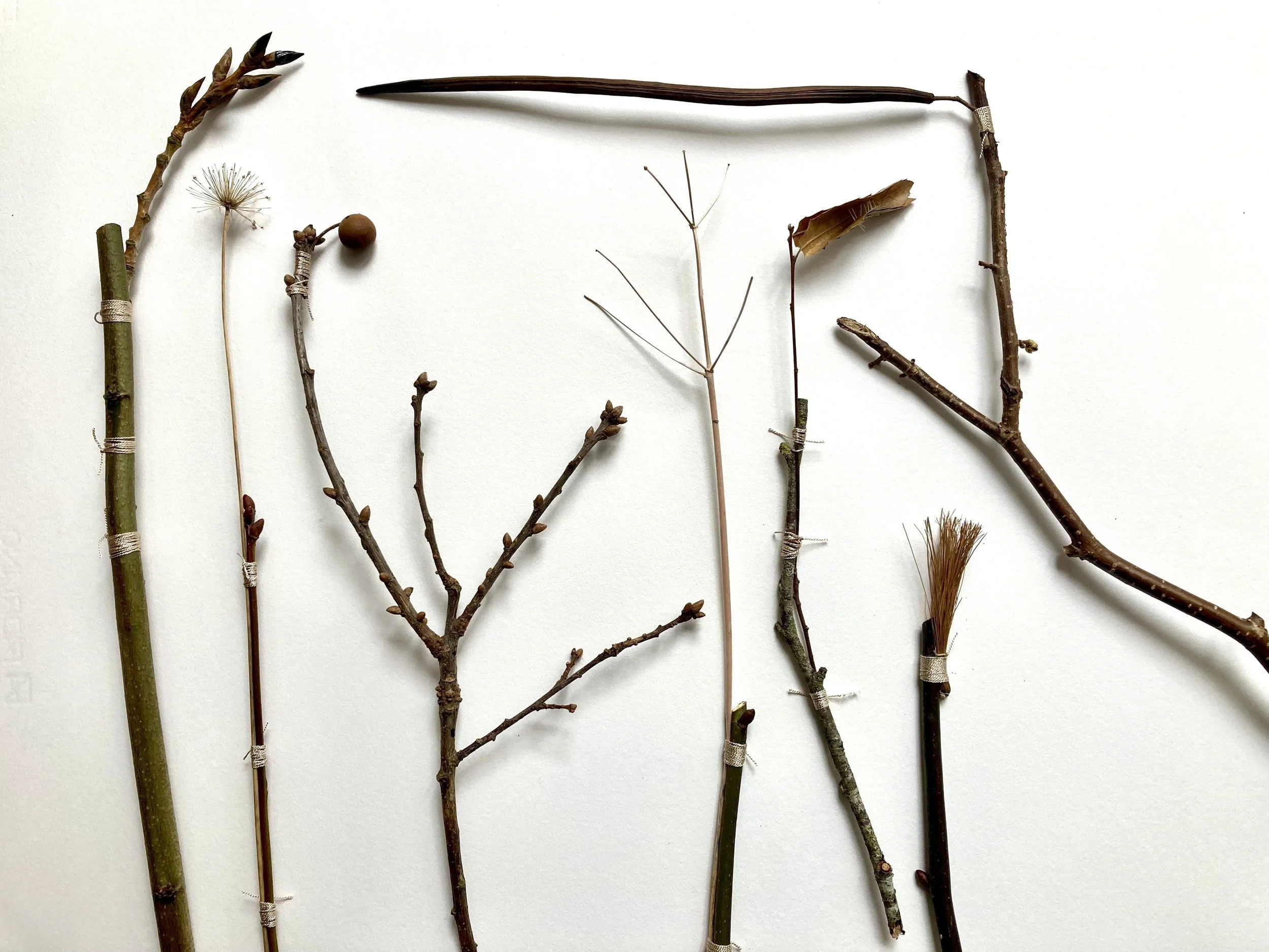
A series of dot and line makers.
Materials: twigs, seedheads and silk thread
Alice Clark’s practice engages closely with nature examining the fragility of our connections with the earth’s ecosystem in the light of human exploitation and overreach. She focusses on plants and the intersection between our nurturing of them and their own resilient, repetitive life cycles.
imagined family
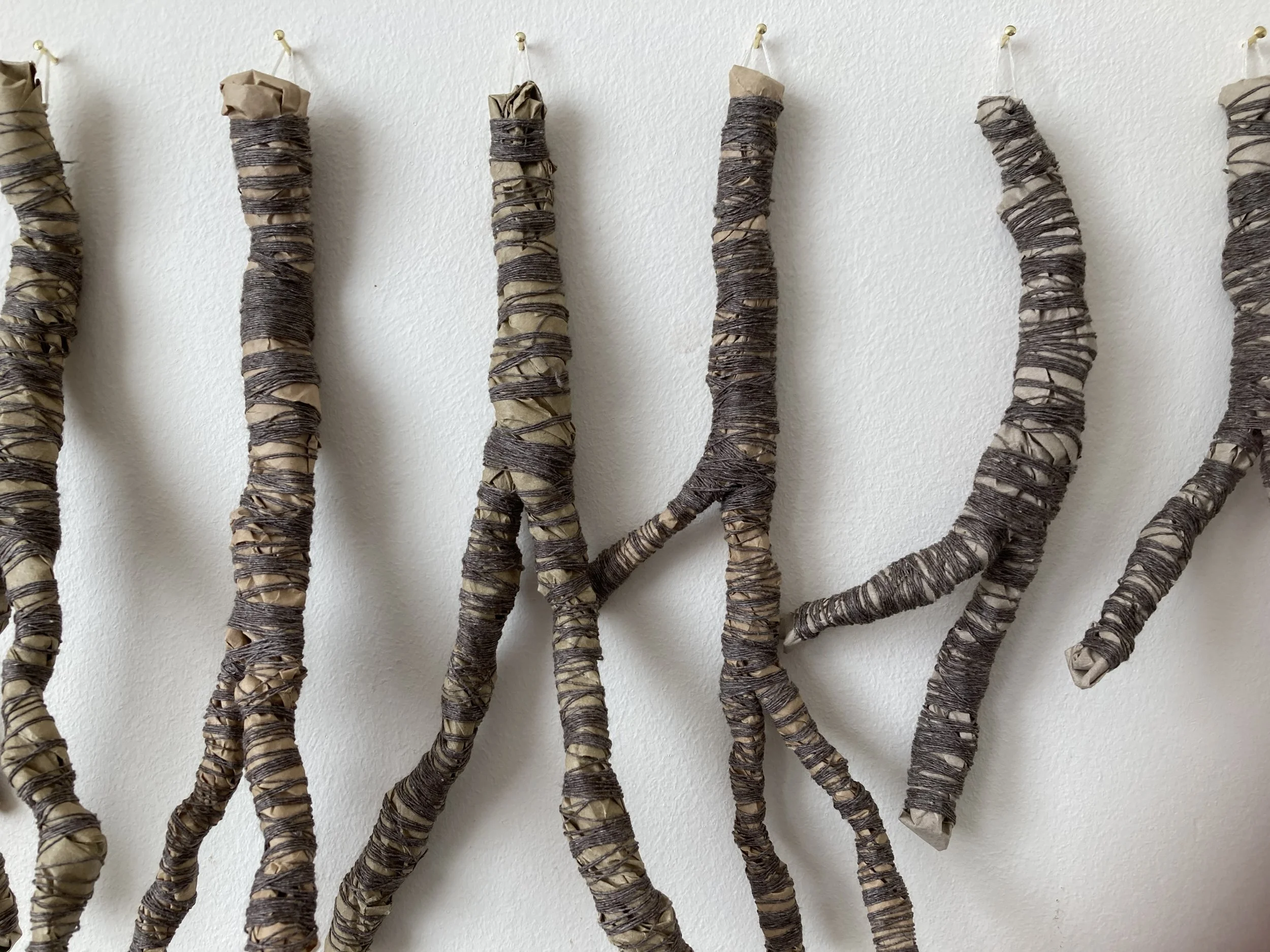
imagined children
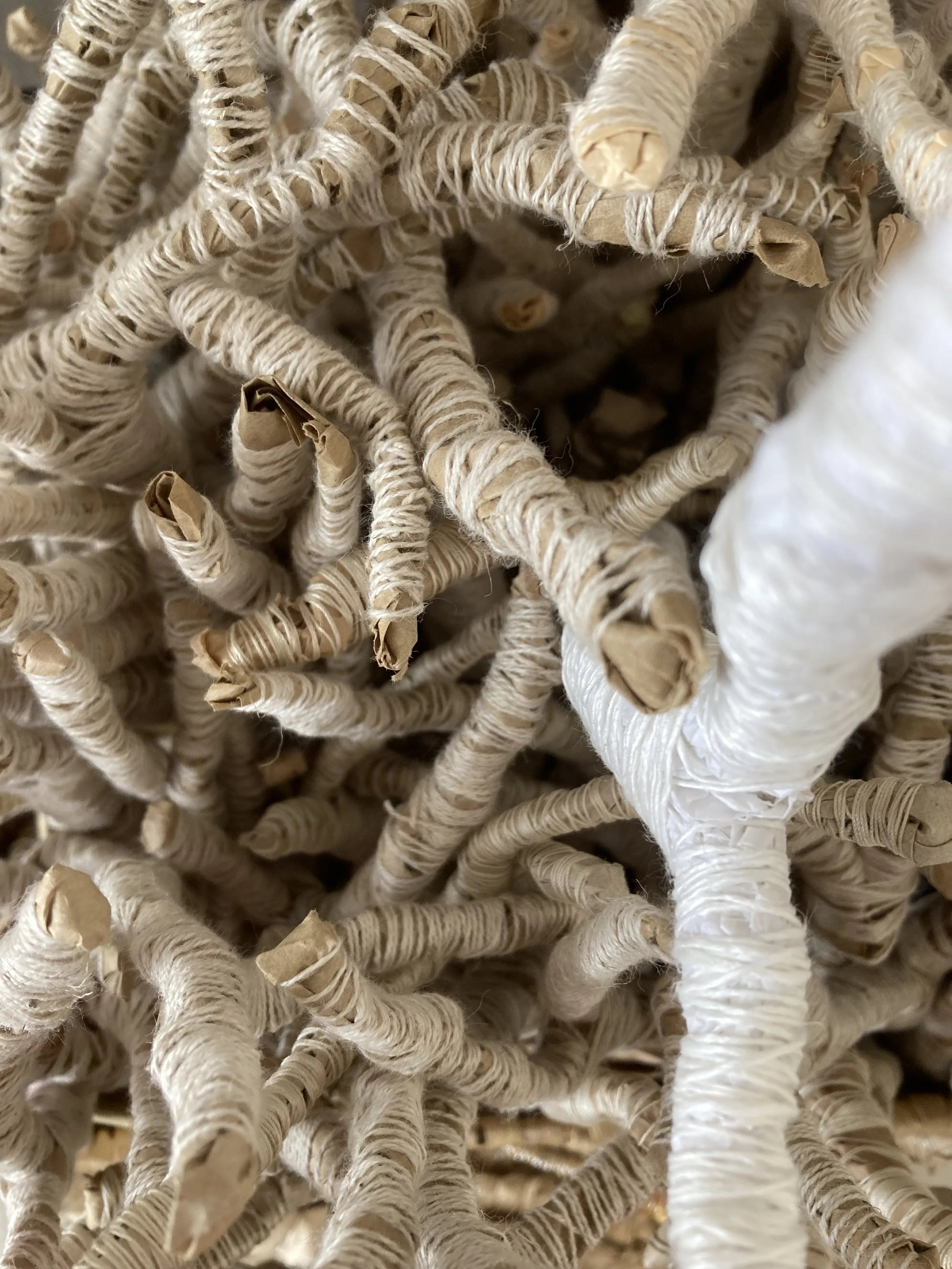
These images form part of the Sticks and Stones body of work, and concern the position and impressions of the child in the family, community and wider society.
These particular works are fabricated twigs, made from recycled packaging materials and dead stock wool and linen thread.
Other works in the series comprise observational drawings on paper and cloth; textile-wrapped collected twigs; songs and sound works.
Elena Thomas has an evolving multi-disciplinary practice that includes drawing, textiles, installation, sound, songwriting and performance. She has a Masters Degree in Arts Practice and Education and is a member of the Royal Birmingham Society of Artists. Her works have been exhibited across the UK, in the USA, Sweden and Greece.
Postpartum Hair Nests (2025)
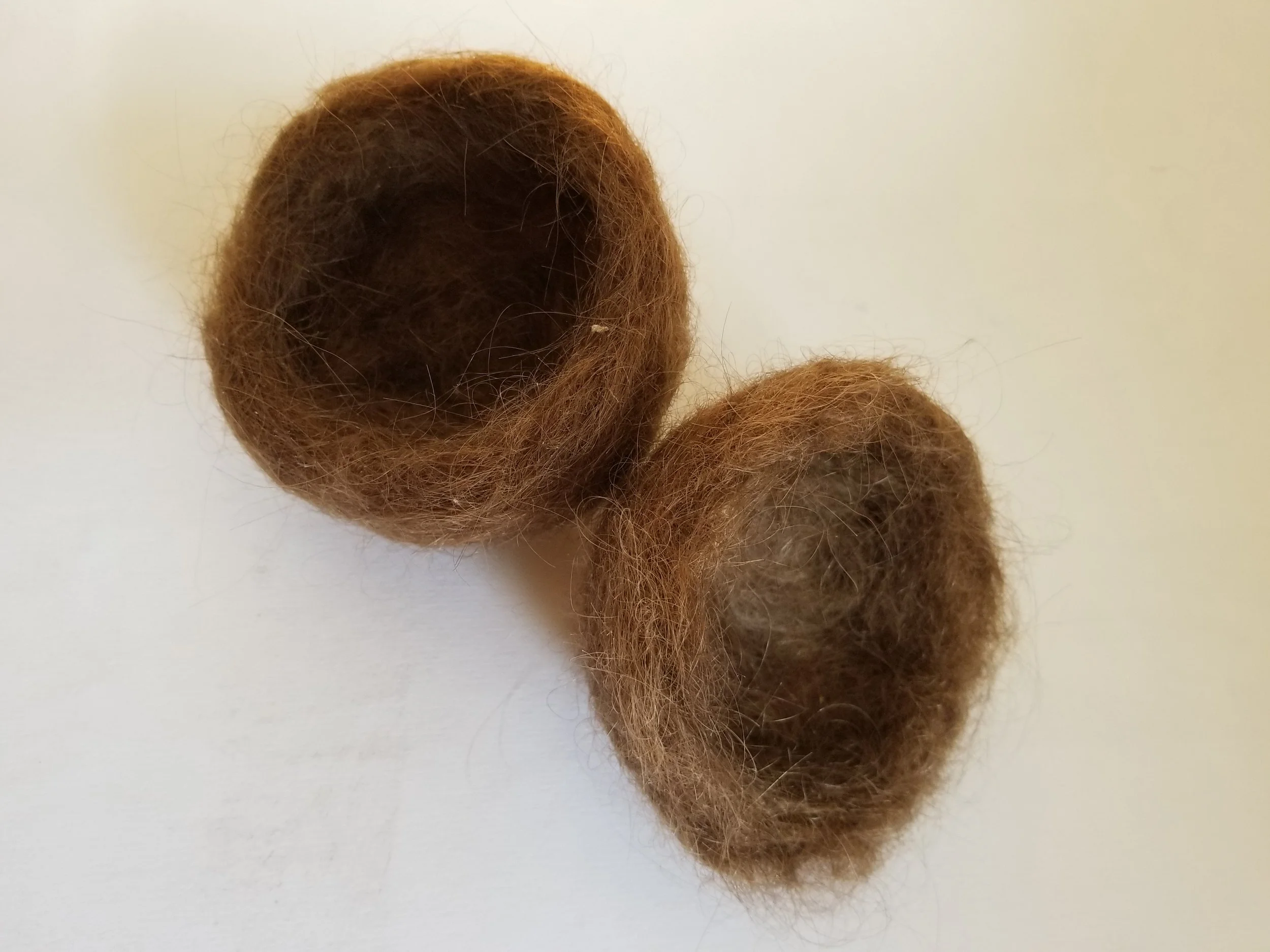
This work is a meditation on motherhood, loss, and care.
Materials: the artist's hair from 2014 after the birth of her child (left), and hair from the past year (right), needle-felted into nest or bowl shapes.
Jessica Marion Barr is an artist, educator, and single mother whose interdisciplinary practice incorporates artmaking and research-creation, investigating collaborative, queer, embodied, and Indigenous-led approaches to environmental and social/ecological issues. An Assistant Professor at Trent University (Ontario), Jessica has exhibited artwork across Canada, and has attended trainings and artist residencies nationally and internationally.
GARDEN THREADS
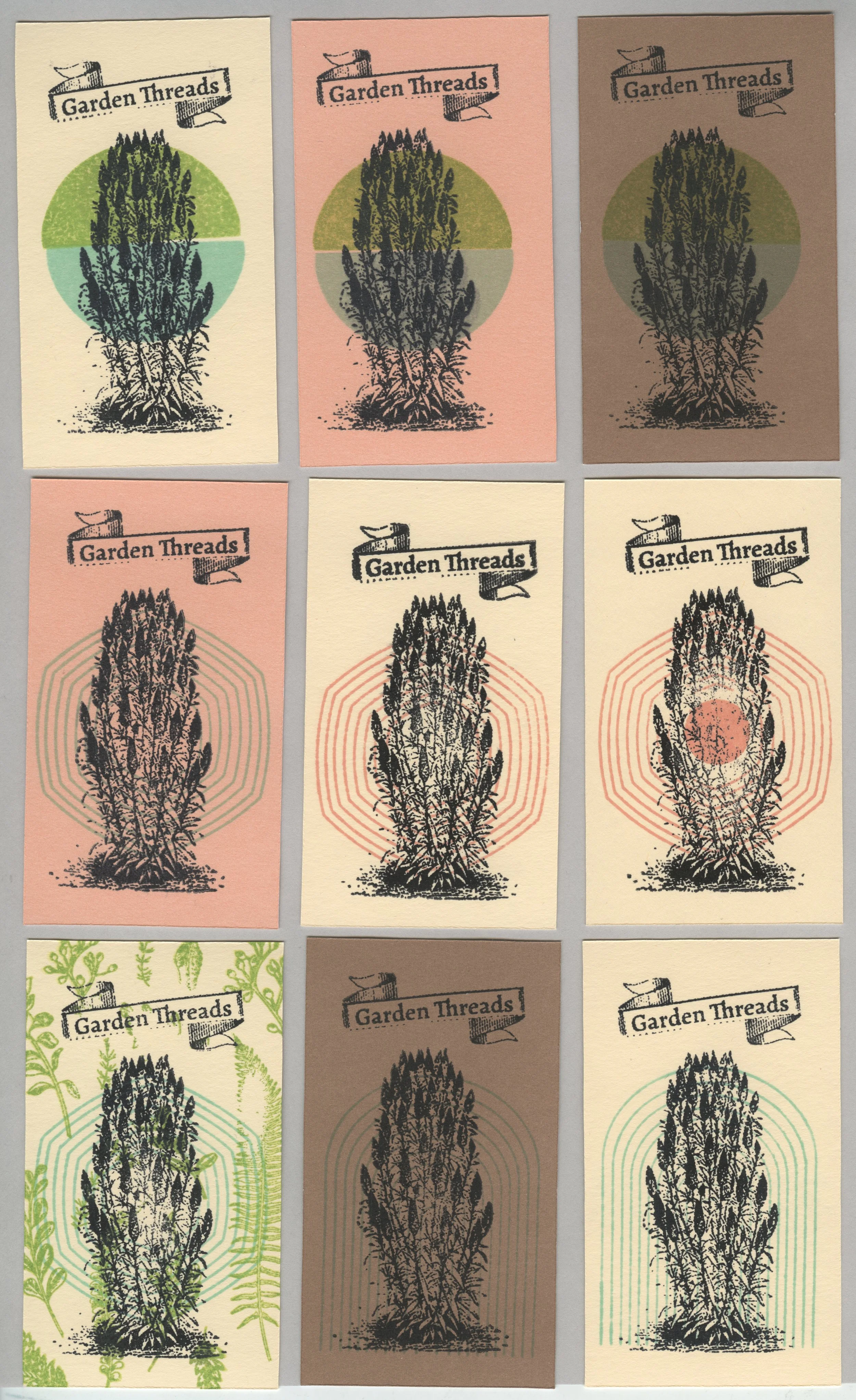
Ellen Mueller (she/her) has exhibited nationally and internationally as an interdisciplinary artist exploring issues related to the environment and capitalism as it affects daily life. She lives and works in Minneapolis, MN, USA.
trace
As threads explore relationship with surface, they leave a trace.
“Like threads, traces abound in the non-human world. They mostly result from the movement of animals, appearing as paths or tracks. The snail leaves an additive trace of slime, but animal tracks are usually reductive, caused by boring in wood or bark, imprinting in the soft surface of mud, sand or snow or, on harder ground, the wear and tear of many feet [...] The word writing originally referred to incisive trace-making of this kind. In Old English the term writing carried the specific meaning 'to incise runic letters in stone' (Howe 1992: 61)."
(Ingold, 2016: 44-46; my emphasis)
I Walk On a thin Line
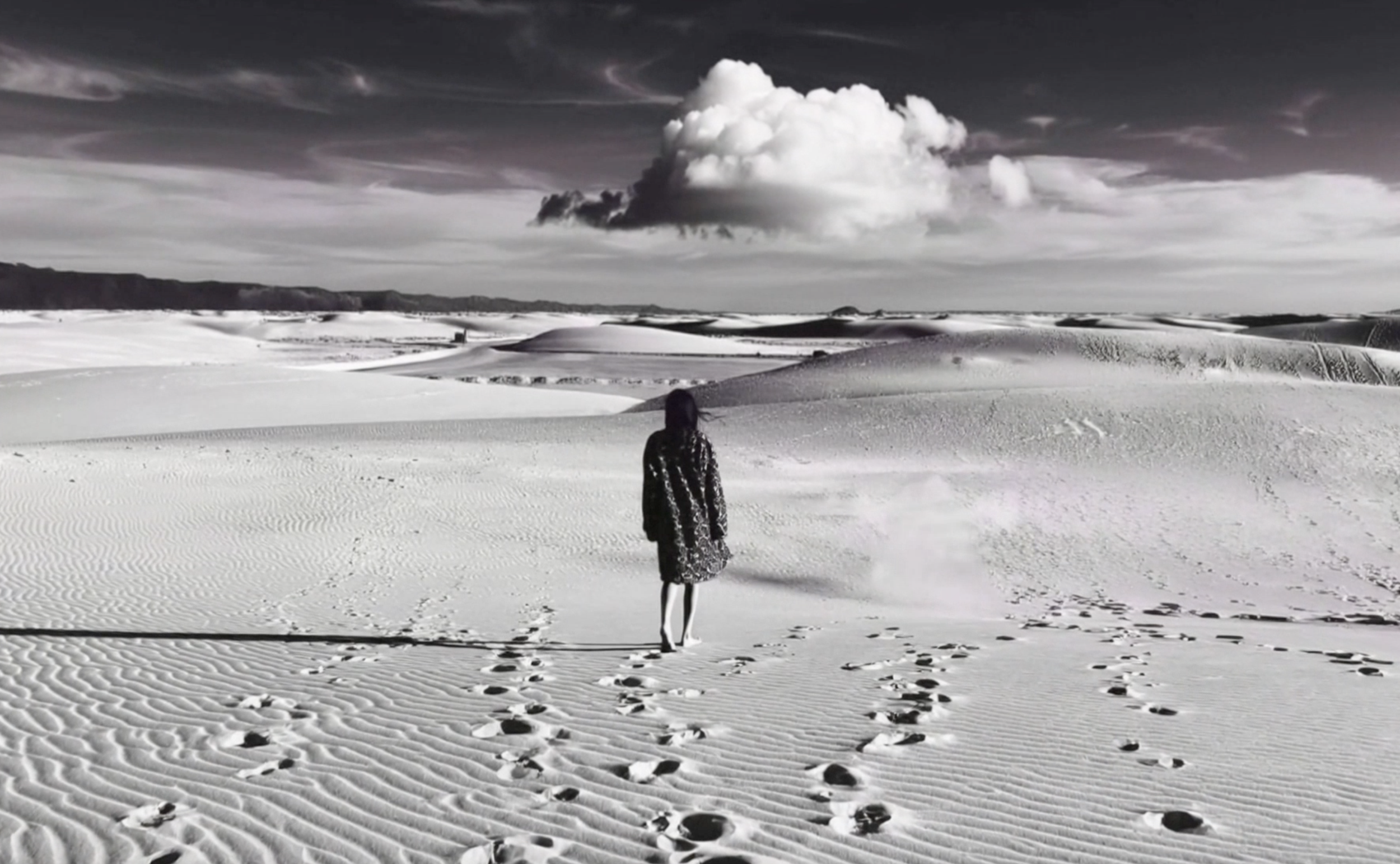
I am walking
on a thin line—
not the kind that breaks,
but hums.
It trembles beneath my weight,
a silver thread pulled taut
between two lands,
two selves.
Below me,
the past breathes like a tide,
salt and names
rising to my ankles.
Above,
a single cloud drifts
I look down once—
the horizon folds
I look forward—
and every step
is a confession
of how much I still want
to stay upright,
to keep going,
to hear the line sing.
Hongru Pan is a Chinese poet and interdisciplinary artist exploring language, sound, and visual media. Educated at UC Davis, Columbia University, and the University of Ljubljana, she co-founded AccentSisters, a vibrant New York art and literary hub. Her works weave culturally diverse aesthetics through meditations on memory and transformation.
BLUE STORM
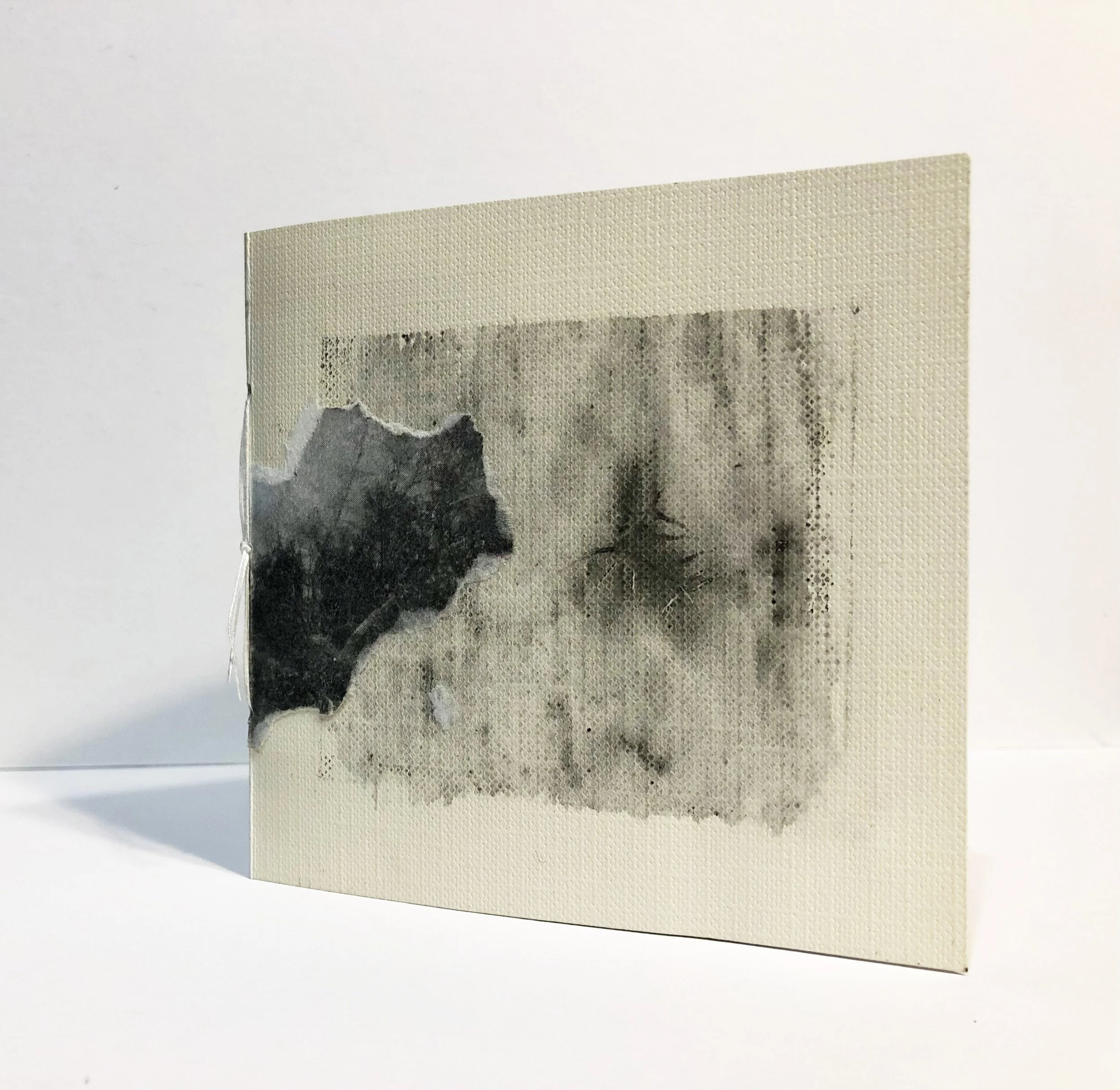
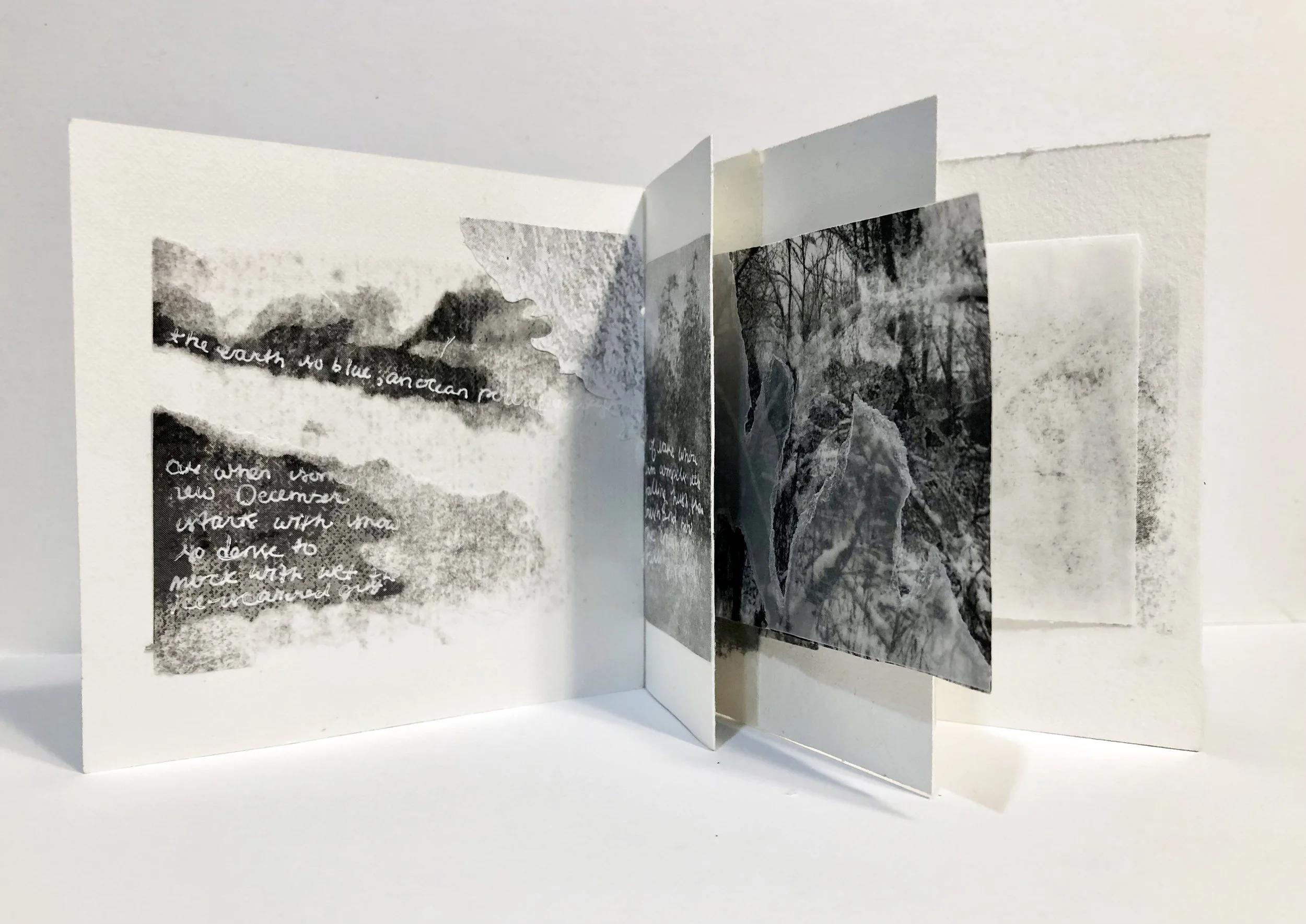
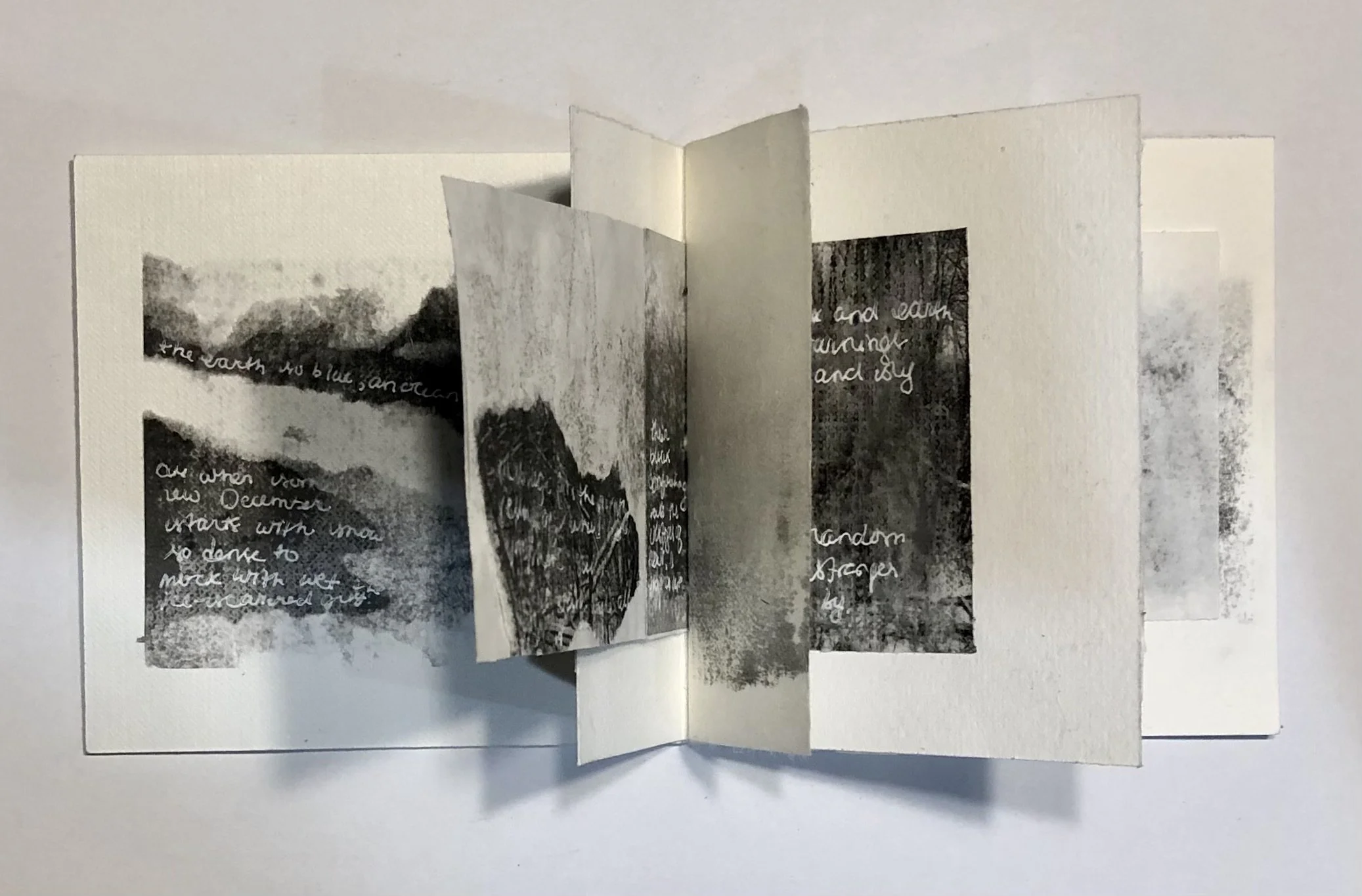
BLUE STORM is a artist's book that depicts the shapes and portals left by a devastating blue storm (a snowstorm characterized by significant depth and water content that lends the heavy snow a blue color) in northeastern Minnesota.
Materials: paper, photographs, Citrasolv, writing, thread.
Natalie Vestin is a Minnesotan writer, artist, rosemaler, and infectious diseases researcher. Her work has been published in Pleiades, The Normal School, Prairie Schooner, and elsewhere.
CARBON BODIES (PART ONE)
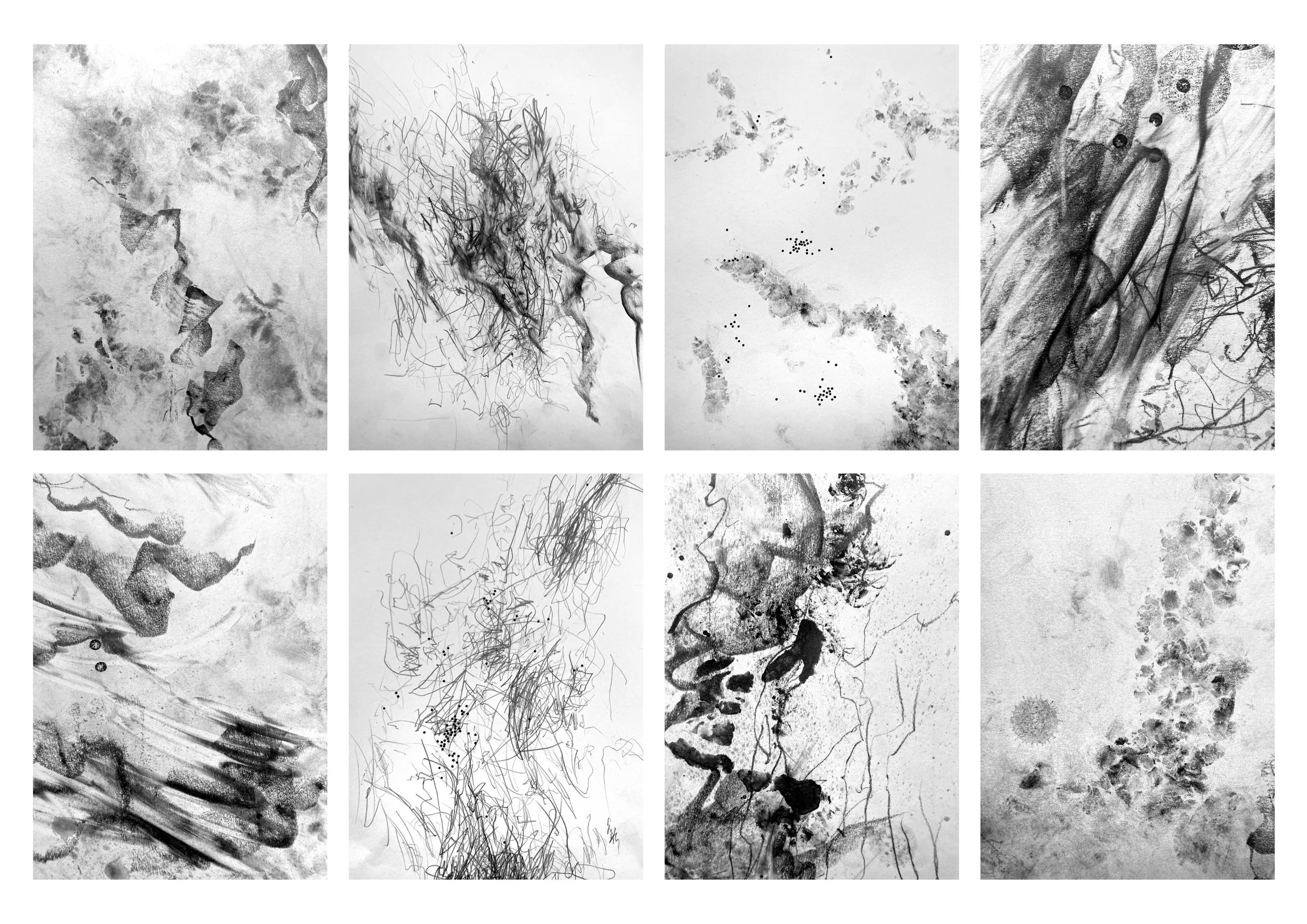
CARBON BODIES is an investigation of a bodily response to and in language. An expanding grammar of graphite marks, traces, blobs. These are the somatic event of the as–yet–unexpressed. The mouth opens and closes but nothing is uttered […] words fail. Watch for the bodily glitch as internal and external processes [mis]align. As my work retreats from textuality, the full stops are untethered from language, leaving them pointing at potential locations which remain incoherent. Fragments from these drawings have formed the basis of an artist’s pamphlet of the same title published by No Press, Canada, 2025.
Rachel Smith is an artist and visual poet, works across drawing, writing and printmaking, to produce artist books. Her hybrid practice flies through existing texts, embracing association, error, distraction, and a meandering lostness to explore how sense might be sought, rejected, and re-fused for this neuro-queer reader.
Button Blazing Star
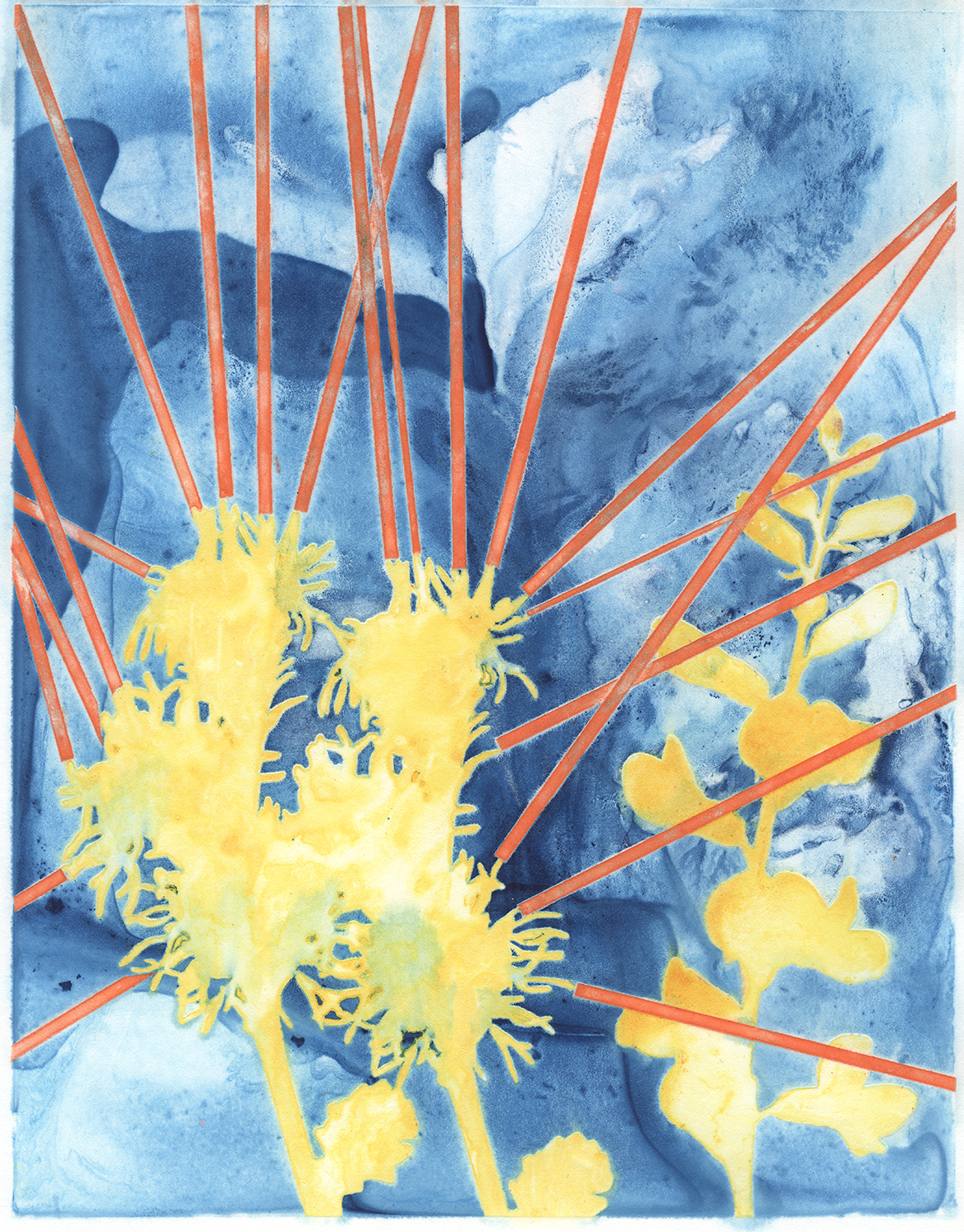
Ellen Mueller (she/her) has exhibited nationally and internationally as an interdisciplinary artist exploring issues related to the environment and capitalism as it affects daily life. She lives and works in Minneapolis, MN, USA.
Beneath
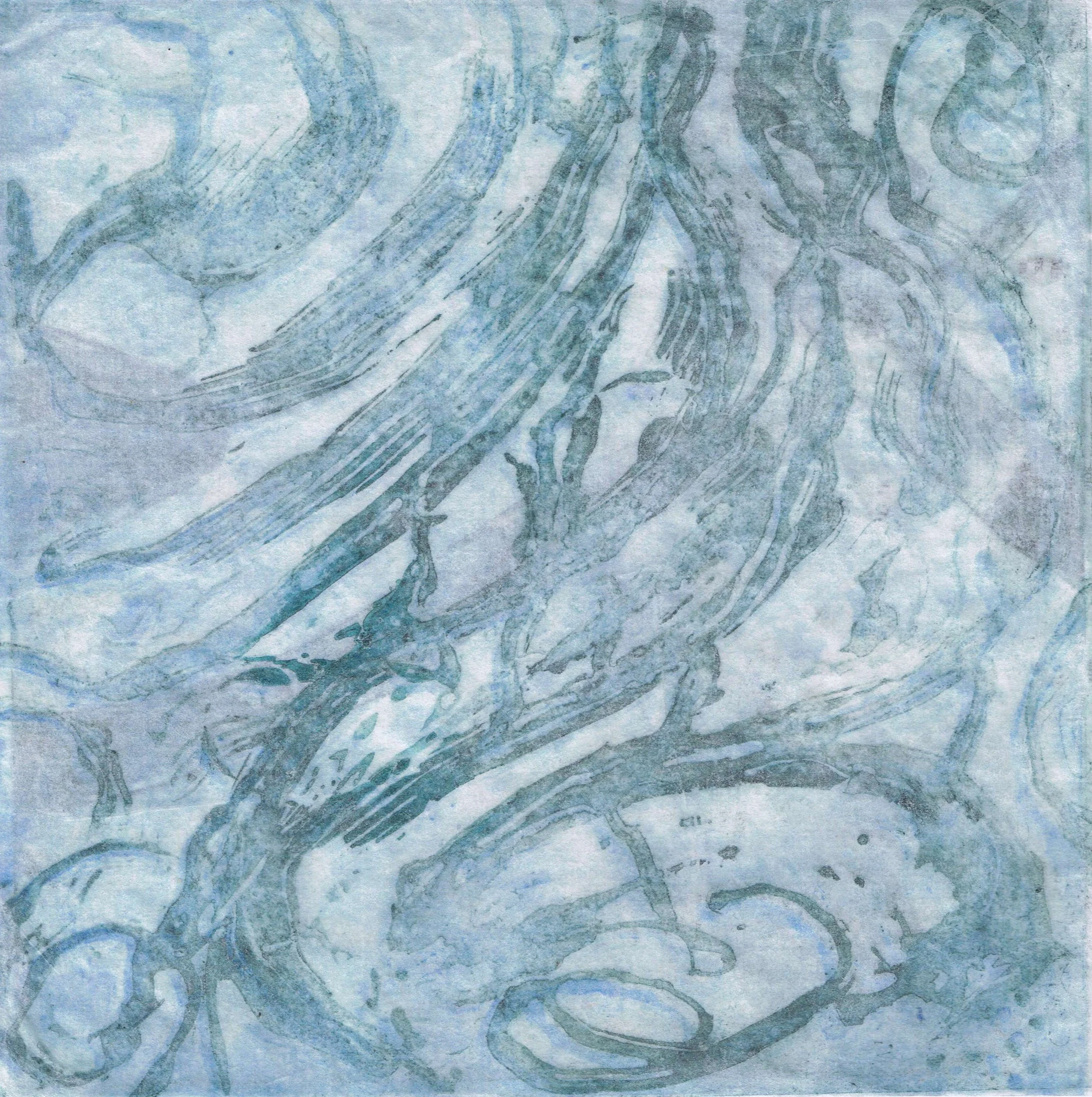
Just 40 years ago, the American eel was an abundant fish species in the Ottawa River. Since then, the population has declined by 99%. Superimposed rice paper prints question whether transition from the “absence of presence” (extirpation) to the “presence of absence” (extinction) is inevitable.
Beth Shepherd is an Ottawa-based visual artist working in printmaking, photography, video, and text. Situated at the intersection of ecology, animal advocacy, and ecocritical art history, her multi-year art-research projects explore the non-human world and humanity’s impacts on it.
bethshepherd.ca / artthatmakesadifference.ca
oak gall drawings
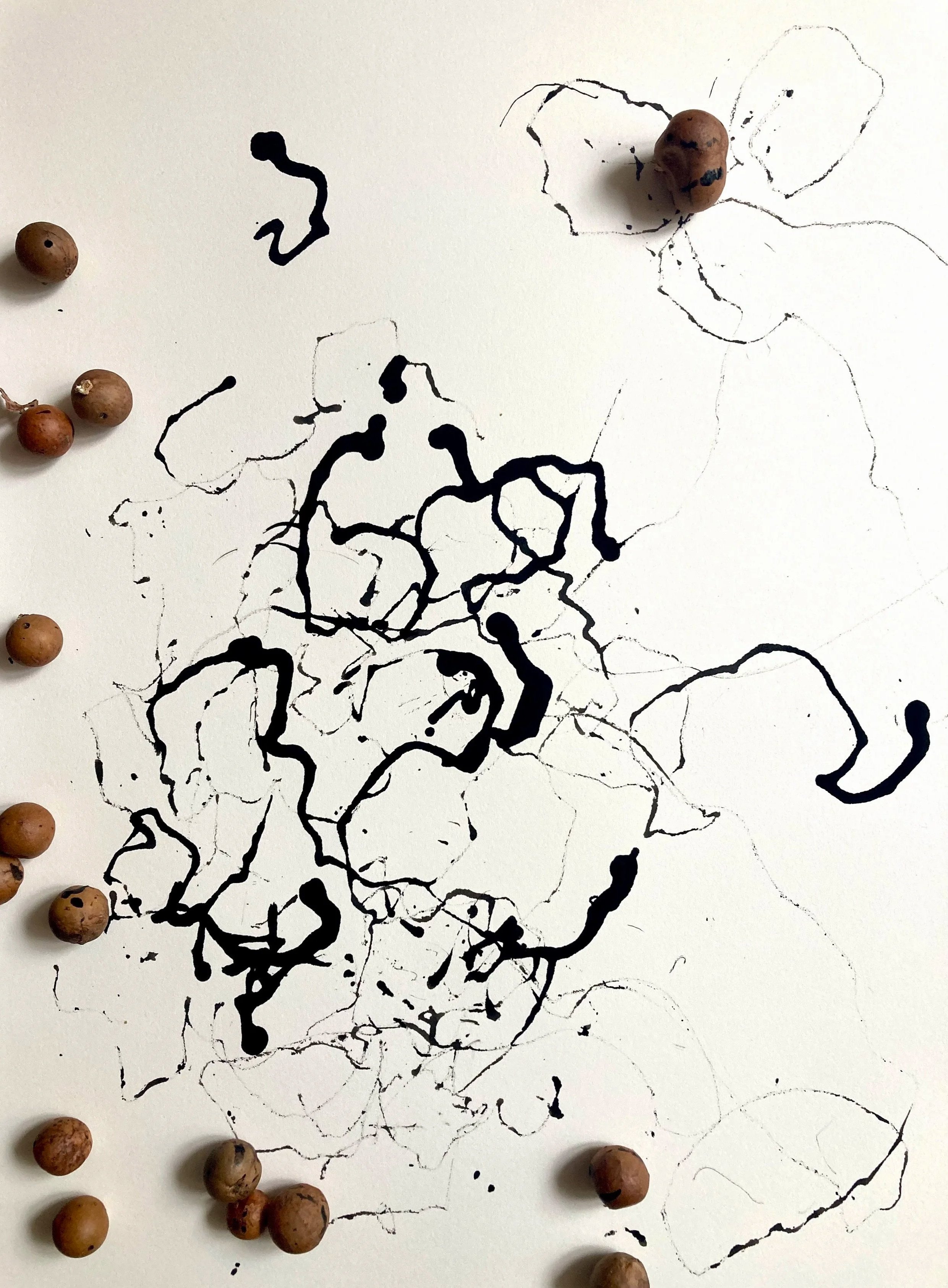
These drawings were made using the oak gall marker pictured in UNSTABLE IMPROBABLE SELF-REFERENTIAL (pictured earlier) in conjunction with a number of other loose oak galls (pictured here).
Alice Clark’s practice engages closely with nature examining the fragility of our connections with the earth’s ecosystem in the light of human exploitation and overreach. She focusses on plants and the intersection between our nurturing of them and their own resilient, repetitive life cycles.
SHADOW LINE
“..what is a thing, or indeed a person, if not a tying together of the lines - the paths of
growth and movement - of all the many constituents gathered there?”
(Ingold, 2016: 5)
So much metaphor that populates ecological writing is thready: tangle, mesh, network, weave. The thread is visible, it is self-supporting, it has volume and mass, it has an incontrovertible presence. We can see it, feel it, sometimes even hear it. We are used to visualising this thready tangle of ecology as such, but what are these invisible threads really? The lines of flight, the emotional bonds, the currents of water and wind? The unseen impressions, the forces that bind and influence?
The more work I do in this area, the more I come to believe that the material, visible threads and traces are the tangible echoes of invisible, energetic threads and traces that run within. The more I come to believe that these invisible forces are primary and world we engage with on a more obvious level is the aftermath, always a few steps behind, a second skin of the invisible line. The plant stem is a visible trace of the flow of water and nutrients from soil to leaf tip, branch end, flower or fruit. This nutrient flow is drawn up from the sun. Does the sun draw the plant up or the soil push it out of the earth? Is it both? The visible plant parts produce tangible counterparts of the less visible forces, bonds, flows, that drive and feed.
What are the invisible lines that drive and feed you?
blueprint

Selby McCreery’s practice is one of noticing and drawing attention: “I use primarily words, photography and installation to explore consciousness and existence. Tracking the emergent beauty in the everyday, I condense these experiences into poetic participatory spaces and material to nourish and inspire others, I hope, to cherish life.”
untitled
Alice Clark’s practice engages closely with nature examining the fragility of our connections with the earth’s ecosystem in the light of human exploitation and overreach. She focusses on plants and the intersection between our nurturing of them and their own resilient, repetitive life cycles.
specular reflection
Karen Neuberg is the author of the full-length poetry collection, PURSUIT (Kelsay Press) and three chapbooks including “the elephants are asking” (Glass Lyre). Her poems and collages have appeared in numerous literary journals. She holds an MFA from the New School and is the associate editor of the poetry journal First Literary Review-East.
DISTURBING SURFACES
Marks and traces are drawn or inscribed into or onto surfaces.
Cuts, cracks and creases are “ruptures in the surfaces themselves” (Ingold, 2016: 46).
ELLIPSES
[EXPLODED SILENCE]
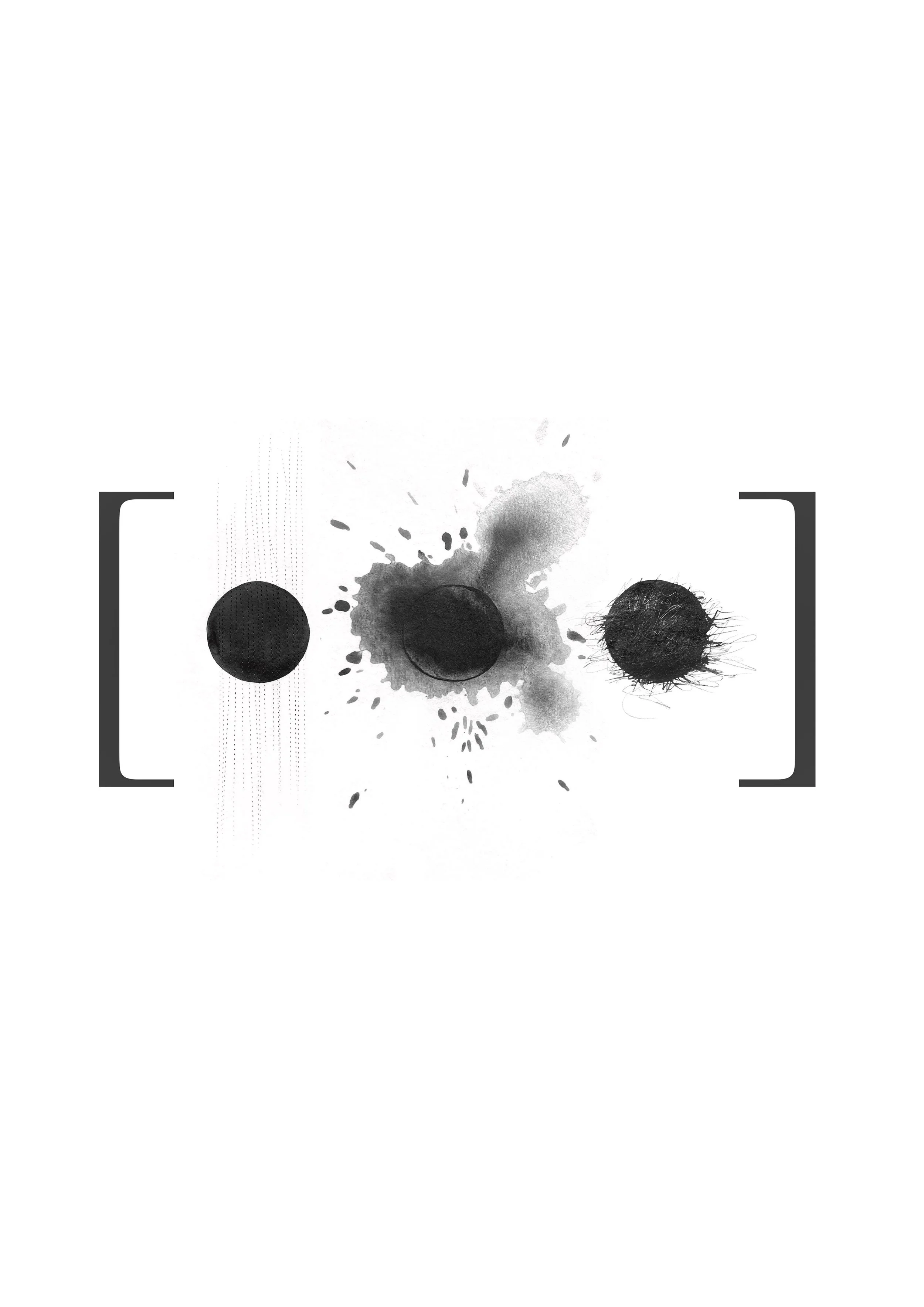
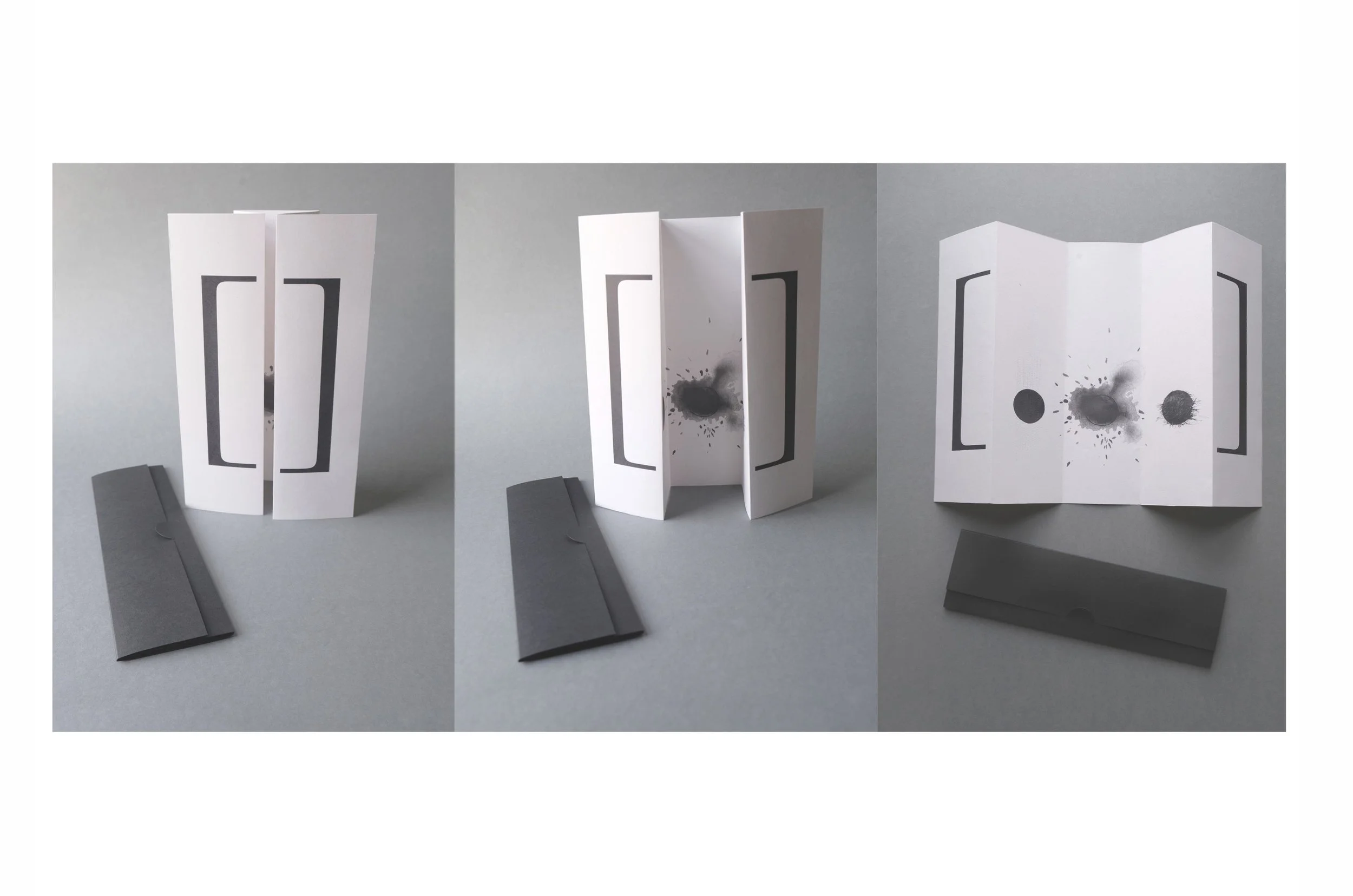
A full stop creates a boundary, a threshold, it insists on exclusion, which in turn creates exclusion, overflow, leakage, excess. The precision of dotting the i’s and crossing the t’s gives way to the bodily flow of the blob, drip, and error ridden stain. The ellipsis visualises something left unsaid, committed form the main body. Here it contains a kind of amplified silence, the precision of the stops are undermined by breaking the edge or surface - the iamb of the perforating wheel, stain of dripped water, and scratched surface.
Rachel Smith is an artist and visual poet, works across drawing, writing and printmaking, to produce artist books. Her hybrid practice flies through existing texts, embracing association, error, distraction, and a meandering lostness to explore how sense might be sought, rejected, and re-fused for this neuro-queer reader.
THE SOIL SHROUD
The video poem documents the examination of a cotton cloth buried in the fall of 2024 and exhumed in the spring of 2025 at Plot 46, an urban farm allotment, for the purpose of understanding the power of the soil food web.
Beth Shepherd is an Ottawa-based visual artist working in printmaking, photography, video, and text. Situated at the intersection of ecology, animal advocacy, and ecocritical art history, her multi-year art-research projects explore the non-human world and humanity’s impacts on it. artthatmakesadifference.ca
100 days of lying down
connecting to those in Palestine
(May - Sep 2025)
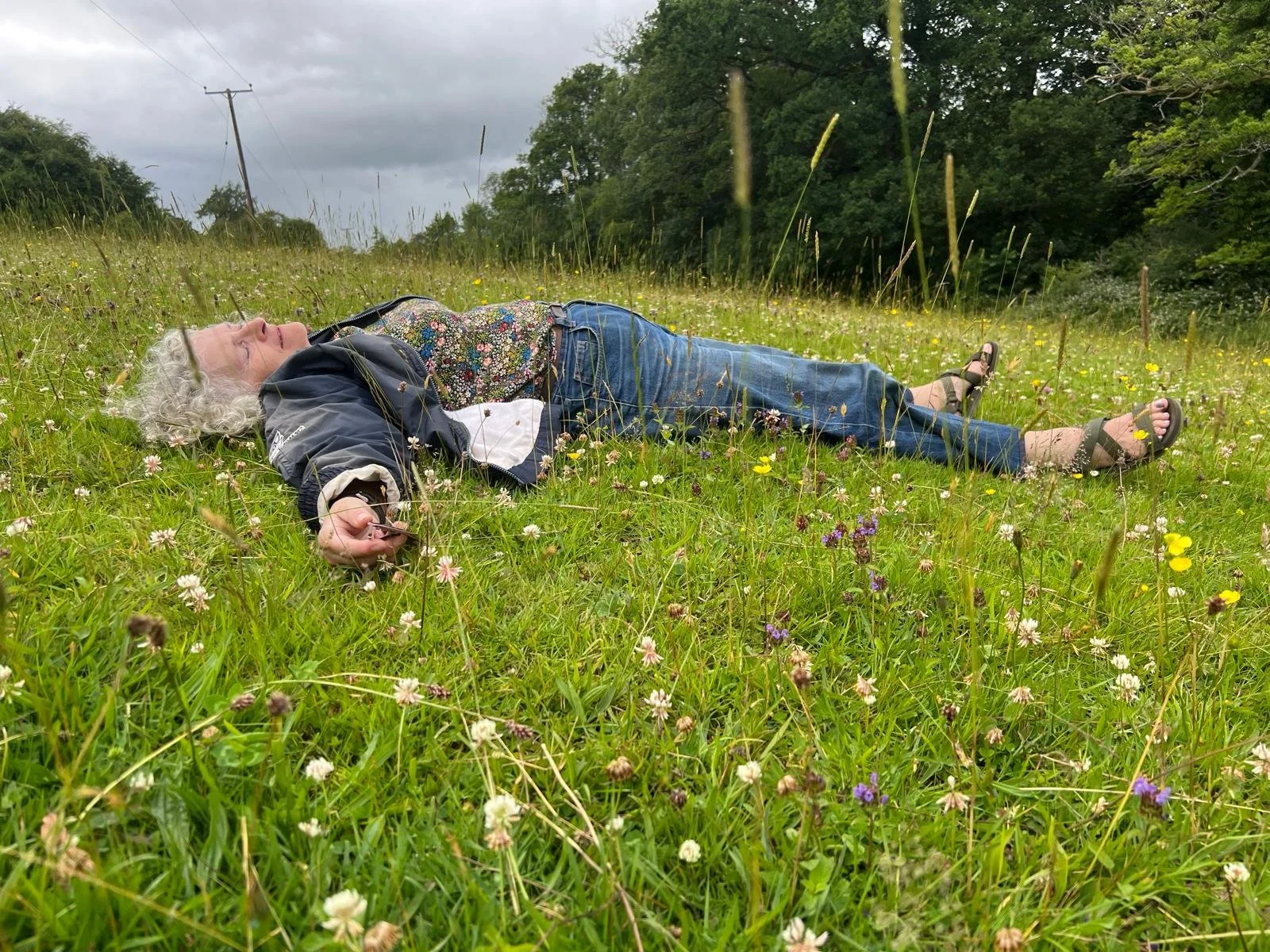
“I wanted to dedicate this act of lying down outside to those suffering and dying in Palestine. It was an act of solidarity, an act of love, an act of determination for peace. These were precious moments during which I noticed more acutely the world around me. I gazed into our shared sky. I allowed my thoughts free rein and aroused my desire for peace to reach out across the globe. Now, I am reflecting on what has happened within me, with the fragile peace process that is ongoing. To be continued.
As a multi media artist, drawing has been at the heart of my creativity, a direct process where images can reveal themselves, as in a conversation. Art making for me centres on curiosity, allowing and flow. As a horn player once said to me, ‘it’s just air in and air out with hopefully transformation on the way’. I feel similarly, that paying attention and being in the moment creates space for creative expression to emerge. This impacts my live art and improvised performances.” Tessa Waite
score
What’s the score?
A scratched mark - a reductive trace (writan - Old English; inscription) - a line made my removing the surface: this mark leads us backwards, telling us something about what happened, physically and materially.
A blueprint. A plan. A notation meant to guide and inspire future action.
A tally of points won during a match or game.
A record of past happening.
SCHOOL REPORTS
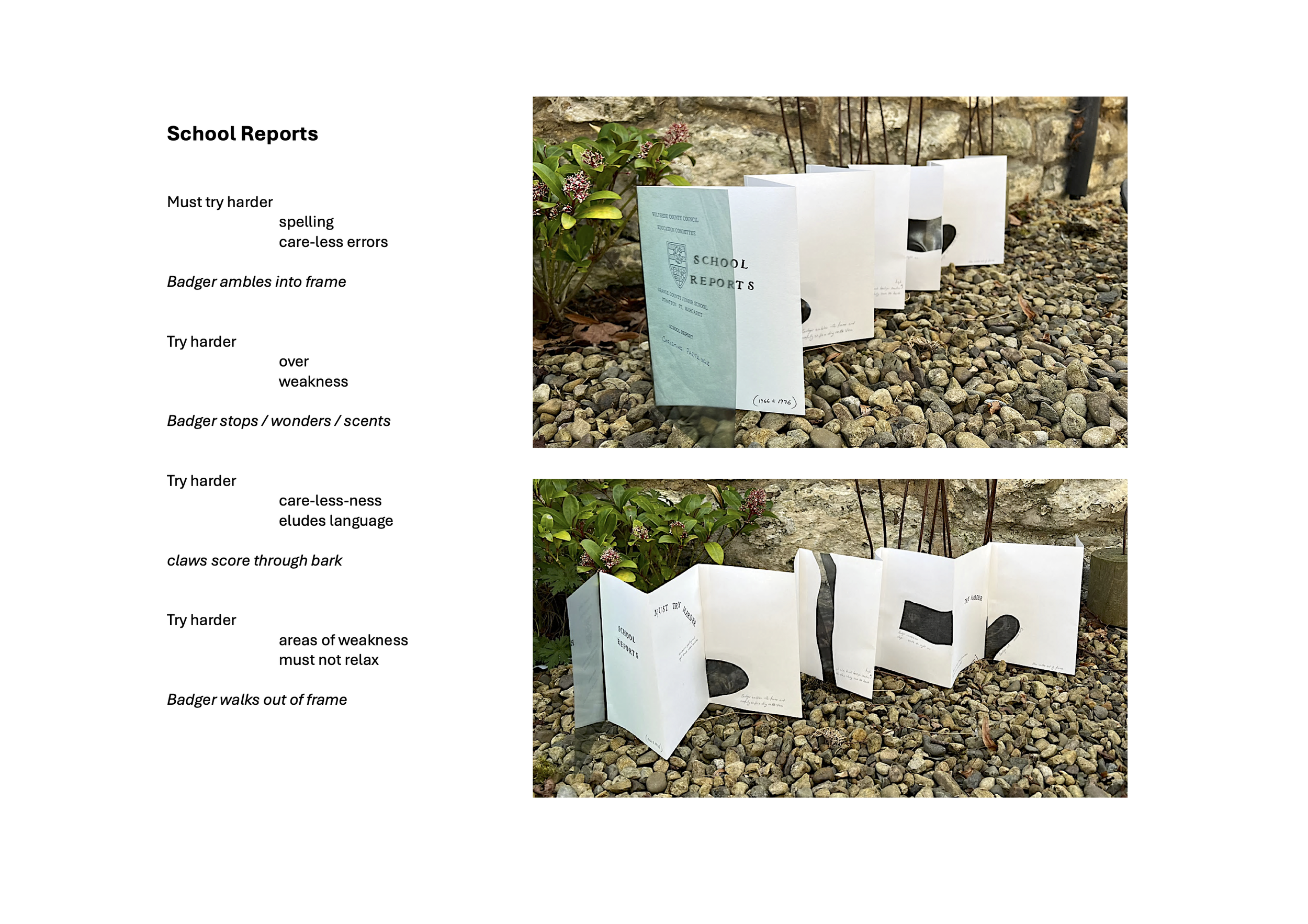
Chris Partridge is a visual artist and poet. Her place of thinking-through-doing is rural Northumberland, home to buzzard and badger. A place layered with stories of ownership, extraction and re-wilding; where rusty wire becomes ‘bodies’ in the landscape, nettles are woven into string and poems become objects subject to continual transformation.
Coal Scores: A Crip Drift
Audio Description of the video: https://soundcloud.com/petra-kuppers/coal-scores-audio-description
Dir/edit: Petra Kuppers
Found performances with Alison and Matilda
The Olimpias Disability Culture Productions
Coal Scores: Crip Drift and sound recordings at the Bergbau Museum (mining museum) in Bochum, Germany, March 2025 - ambient sound scores and found performances by disabled people visiting the mining world.
Crip Drifts are methods for moving through the world as a disabled artist living with pain: touching, being-with, sensing in a world that is likewise disabled, compromised, thriving in complexity.
Petra Kuppers is a disability culture activist and community performance artist. Her fourth poetry collection is Diver Beneath the Street (2024) — true crime meets ecopoetry at the level of the soil, at the membrane of life and death. She co-directs Turtle Disco, a disability culture somatic writing space in Ypsilanti, and is currently at work on Planting Disabled Futures, a virtual reality/community performance project, as a Just Tech Fellow (2024-2026). She teaches at the University of Michigan.
www.petrakuppers.com
REFUG[U]E FOR THREE VOICES
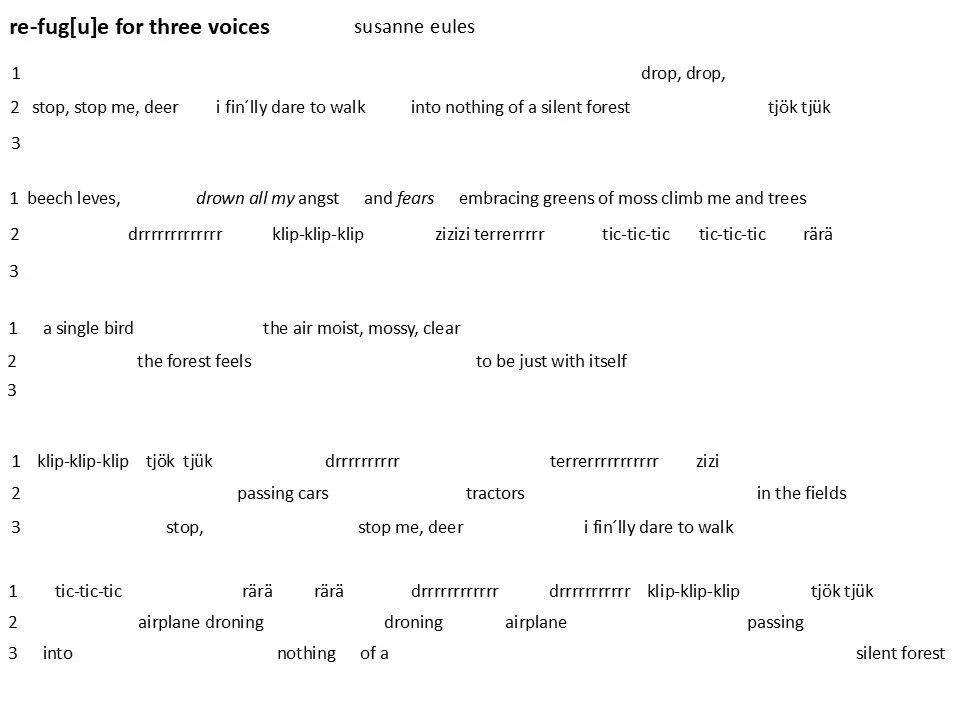
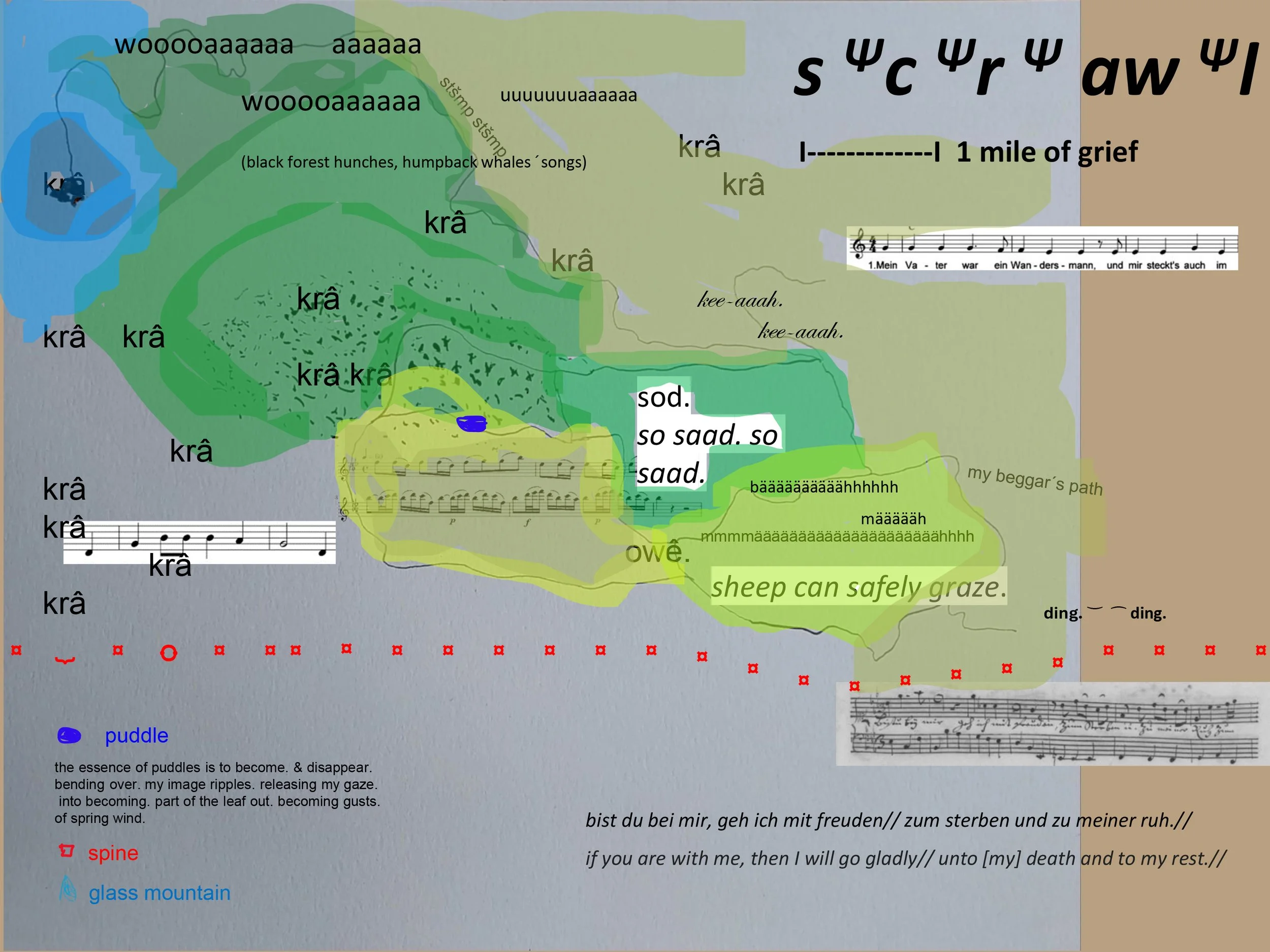
susanne eules is a German American transdisciplinary artist in the fields of experimental, visual, and sonic poetry, performance, and visual arts. They are the recipient of the German Award for Nature Writing 2023 for miami t:ex[i]ting. Full length publications include nivolog (Contraband, UK 2023), der kønig.innen hasen hůten (Austria, 2016), ůbern růckn des atlantiks/den rand des nachmittags (Germany, 2012) and two chapbooks nivolog and lièvre (USA).
www.susanneeules.net
SCORE FOR A HERONRY
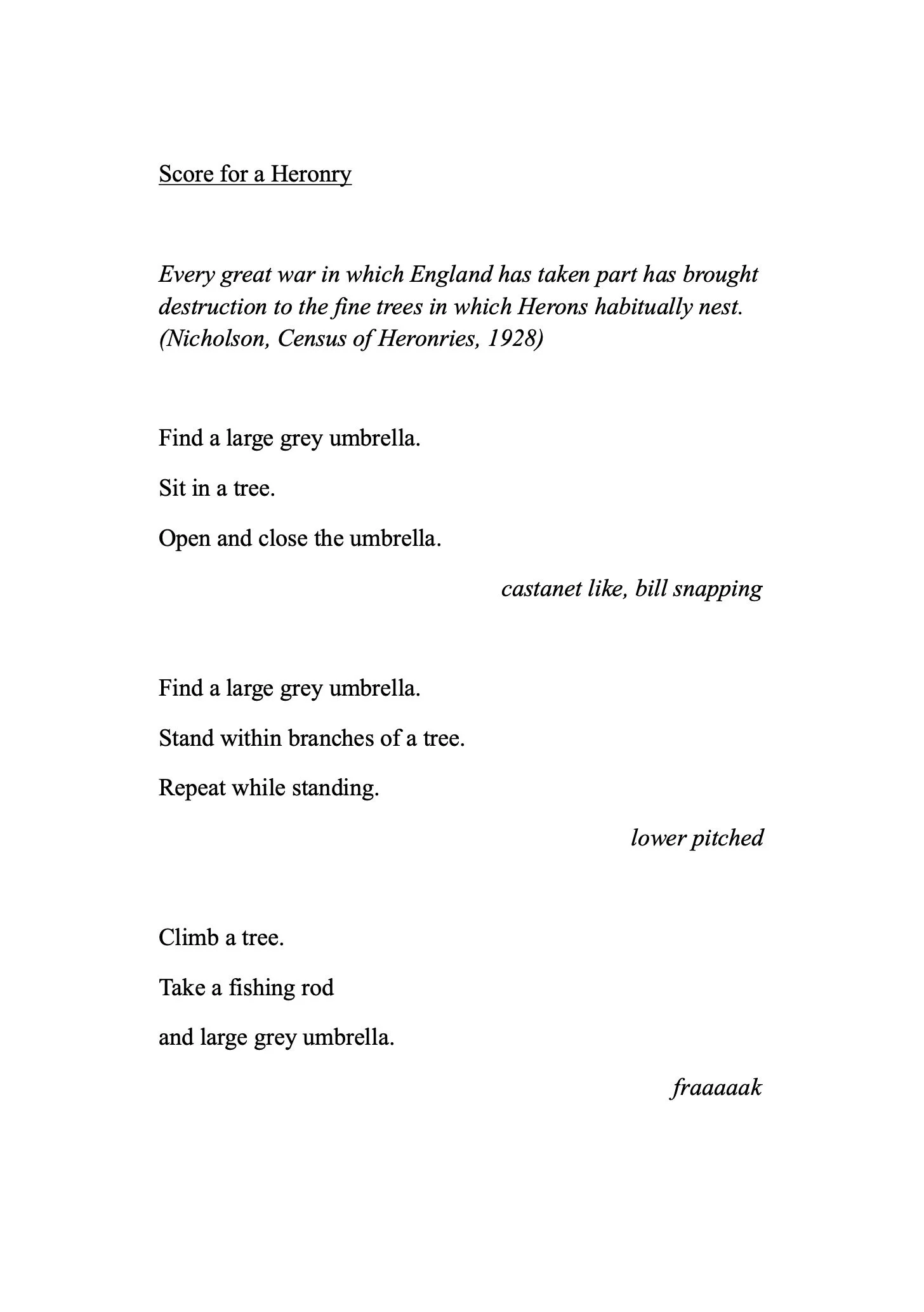
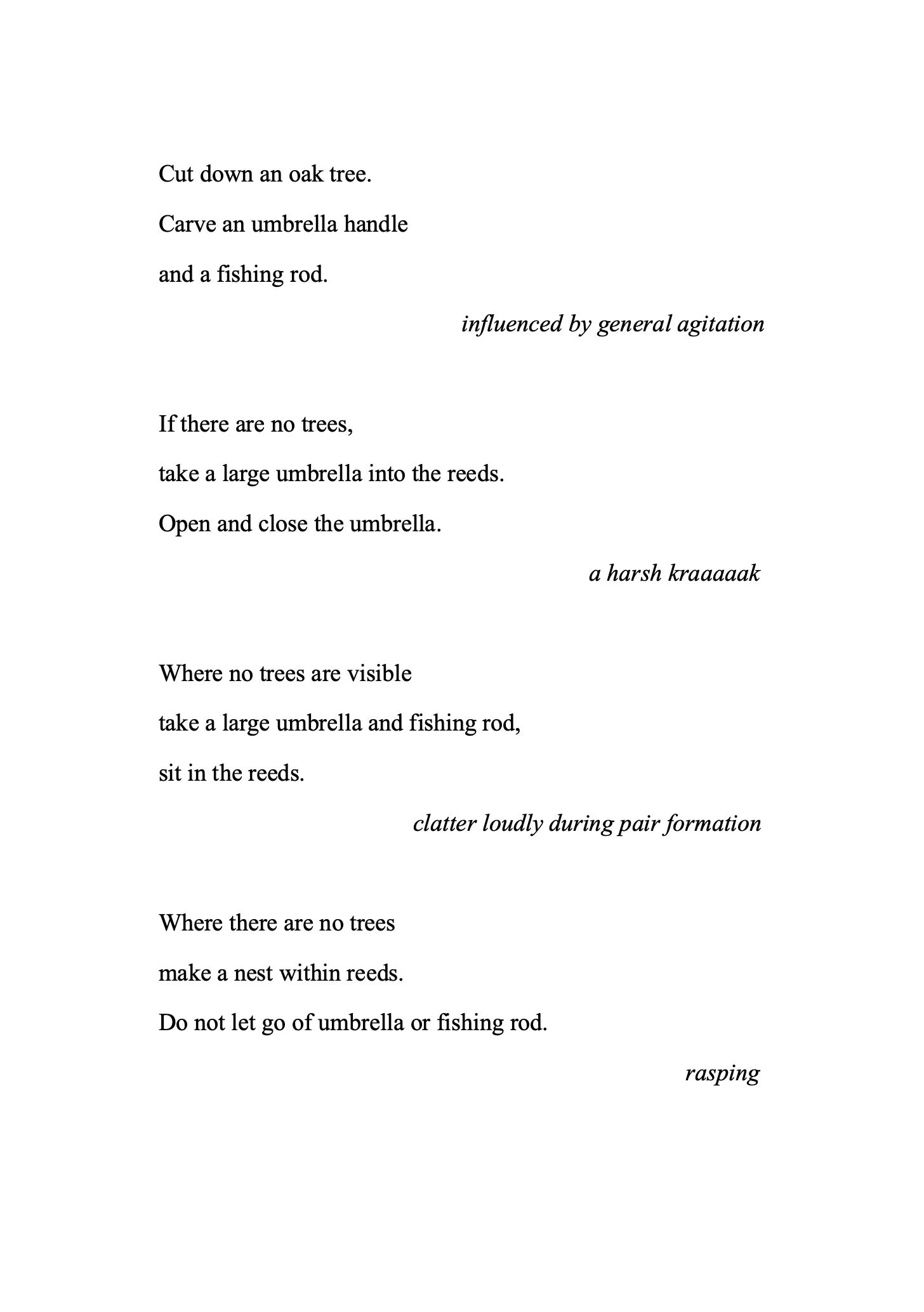
Carol Dalton is a poet based in Kent, UK. She has work published in Datableed, Litmus #5: The Lichen edition, Pamenar Press online magazine, and Multiple Exposures, a digital anthology with Longbarrow Press. She has been longlisted for The National Poetry Competition twice.
Insta: fieldwork.write
STOP TO DRIFT (2025)
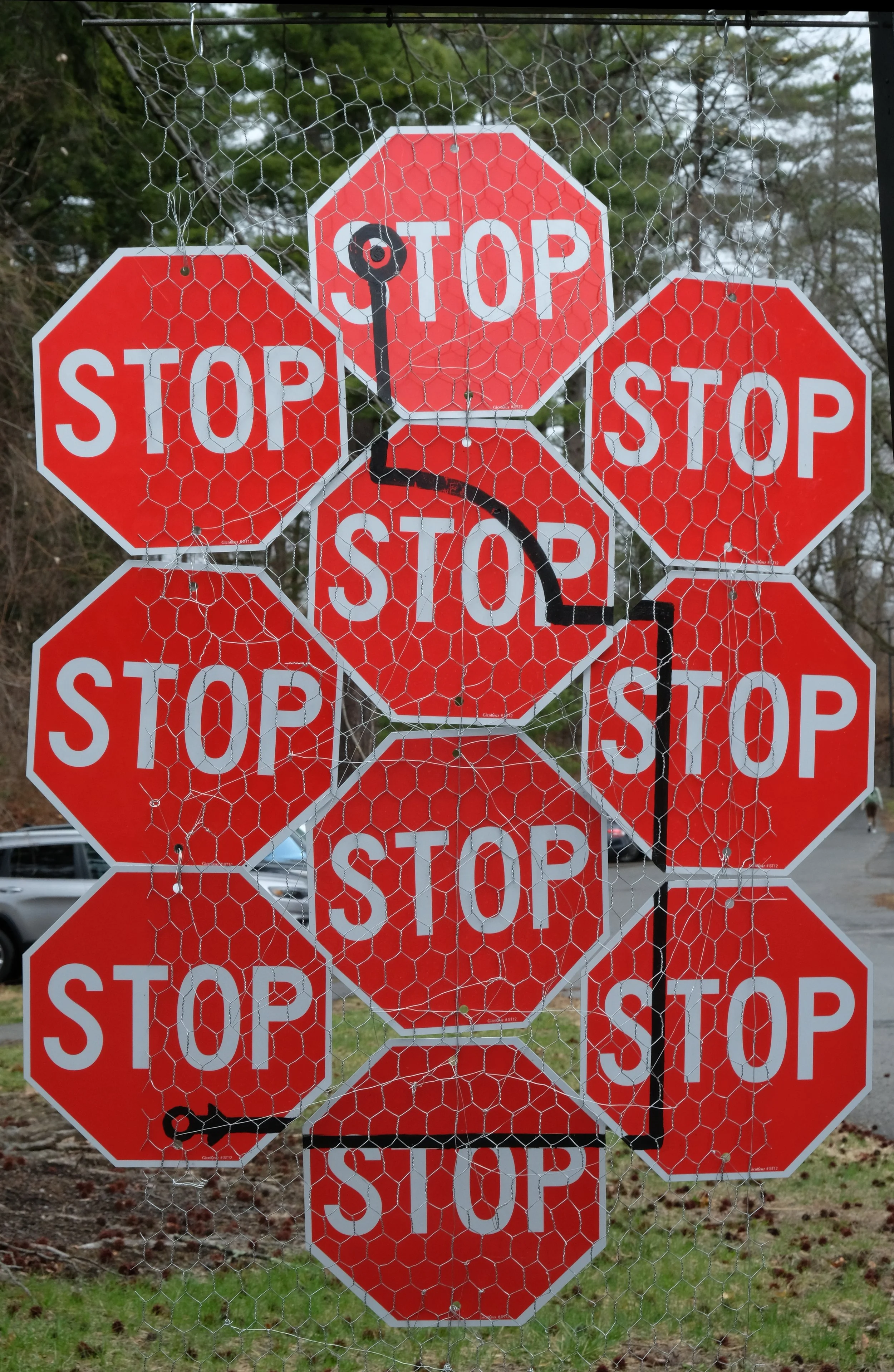
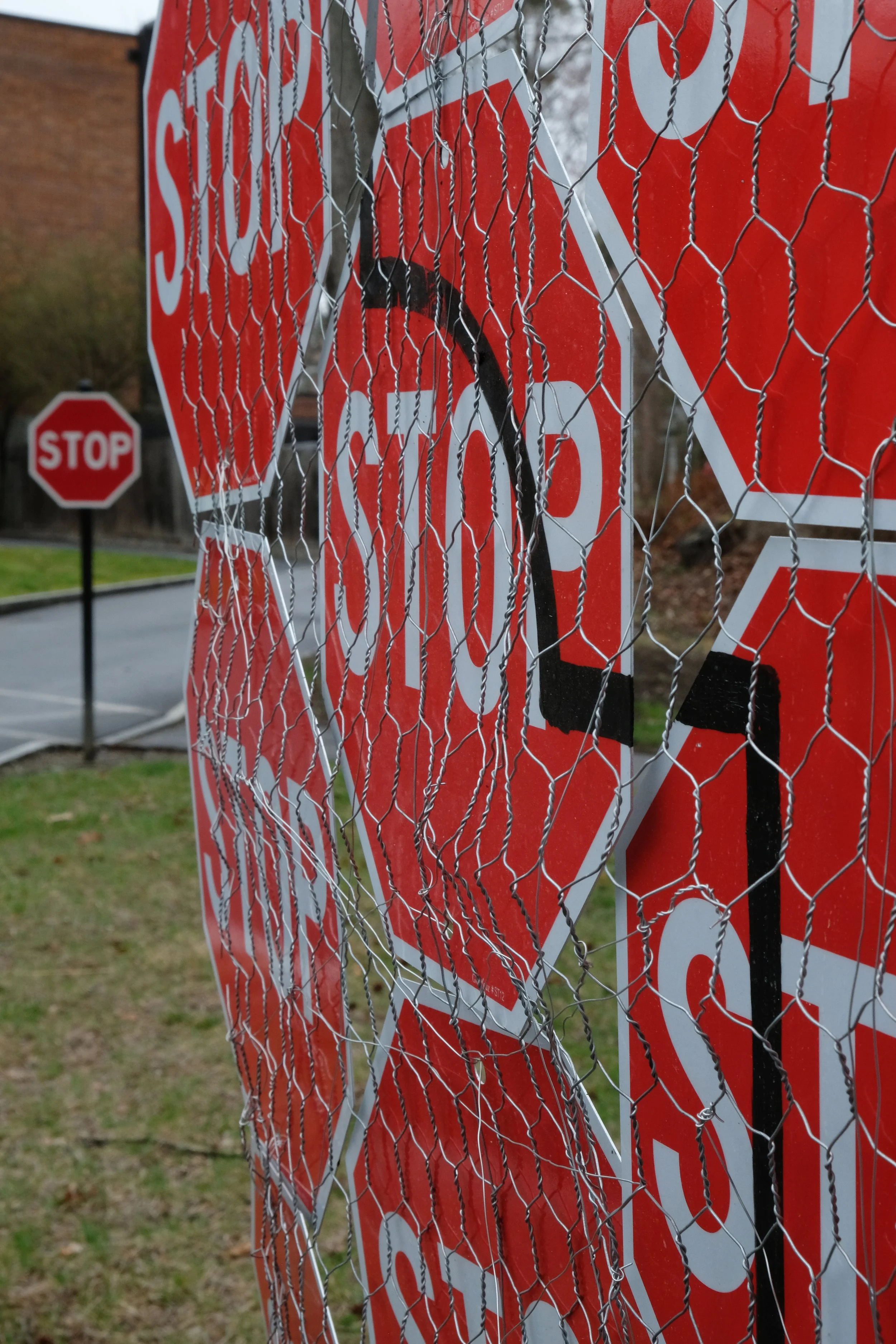
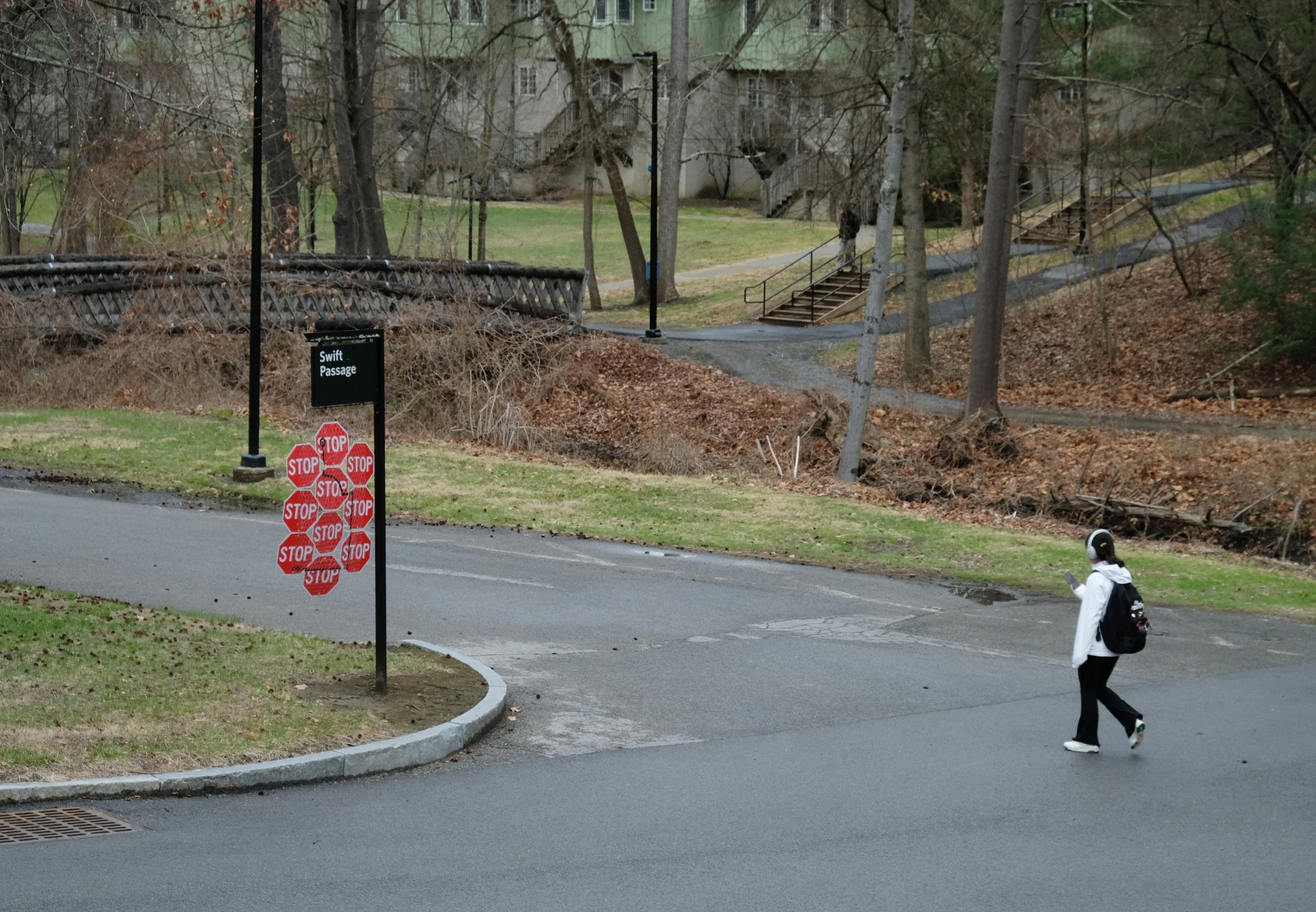
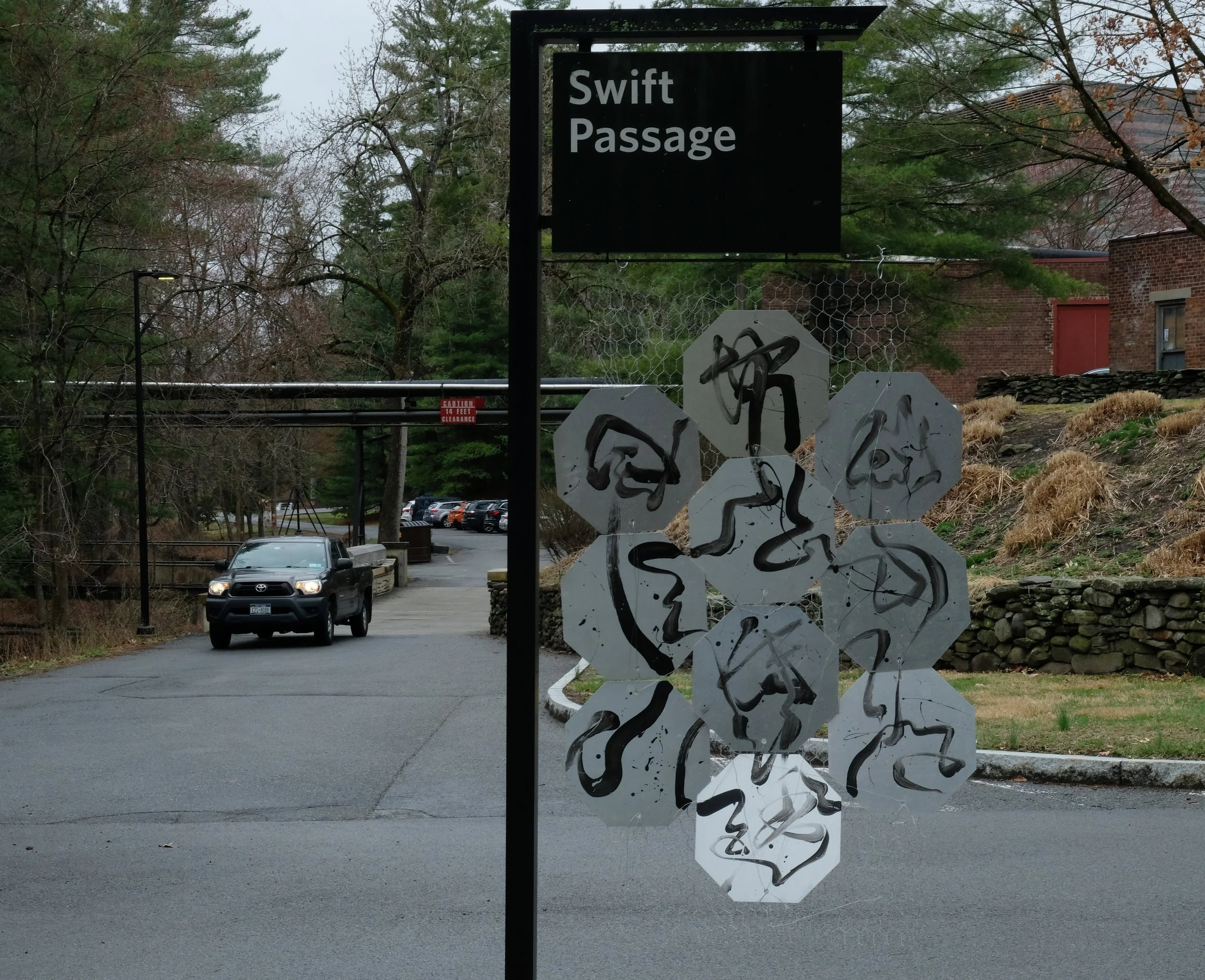
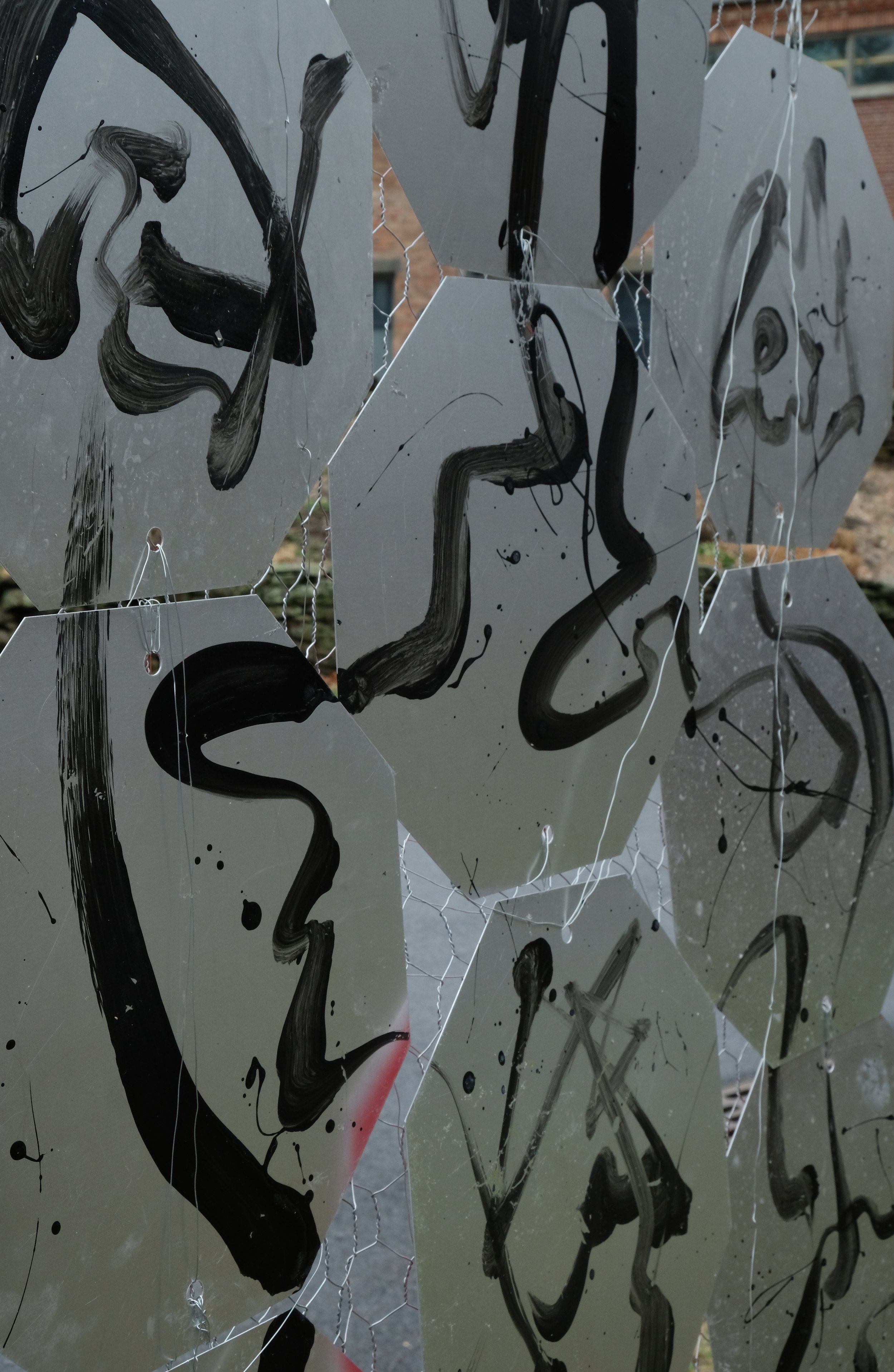
Yixuan Wang is an interdisciplinary artist based between Upstate New York and Beijing China. Self-described as a calligrapher of lines in the world, Yixuan works across drawing, installation, and spatial practice to explore the lines that connect bodies, spaces, and environments. Drawing inspiration from environmental anthropology, Chinese calligraphy, and experimental geography, his work reveals the entanglements between human movement and the surrounding world. Through acts of wandering, tracing, and mapping through diverse territories, he reveals how memories and trajectories interplay with our perception of space. Yixuan Wang holds a Bachelor’s degree in Media Studies and Studio Art from Vassar College.
https://yixuanwangstudio.vassarspaces.net/
transcribing AN ECOSYSTEM
"As Samuel Johnson reminds us in his Dictionary, one of the meanings of the word [line] (the seventeenth and final entry in his list) is 'lint or flax'. Lint is derived from the Latin linea, which originally meant a thread made from flax, linum. These threads were woven into cloth that we now call linen, and that could be used to line garments by providing an extra layer of warmth. And if 'line' began as a thread rather than a trace, so did 'text' begin as a meshwork of interwoven threads rather than of inscribed traces. The verb 'to weave', in Latin, was texere, from which are derived our words 'textile' and - by way of the French tistre - 'tissue', meaning a delicately woven fabric composed of a myriad of interlaced threads." (Ingold - Lines, 2016: 63, italics in original)
Ecology is a word used to describe the material and energetic relationship between organisms and elements. An ecology of line is an examination of the relationship between different forms of line. It is not only a weave, a text, a tissue, an entanglement but a palimpsest. It is not only a presence but an absence: a lack, a tunnel, a surface lined by cracks and creases. Threads displace other threads. Traces overlay, displacing and erasing other traces. The pointed lines of claws or beaks, needles, nails breach outside from inside. Hair and teeth erupt from the surface of skin, protruding from inside to outside. The self-dissolving or self-dispersing line breaks into dots, like seeds or spores, moved by invisible currents of energy in air and water until they make contact with surface and begin to extend threads in roots, make traces, and become thread-like and leave traces again.
These linear movements form an ecology of line.
This is an attempt to transcribe it.
The Sediment of Words
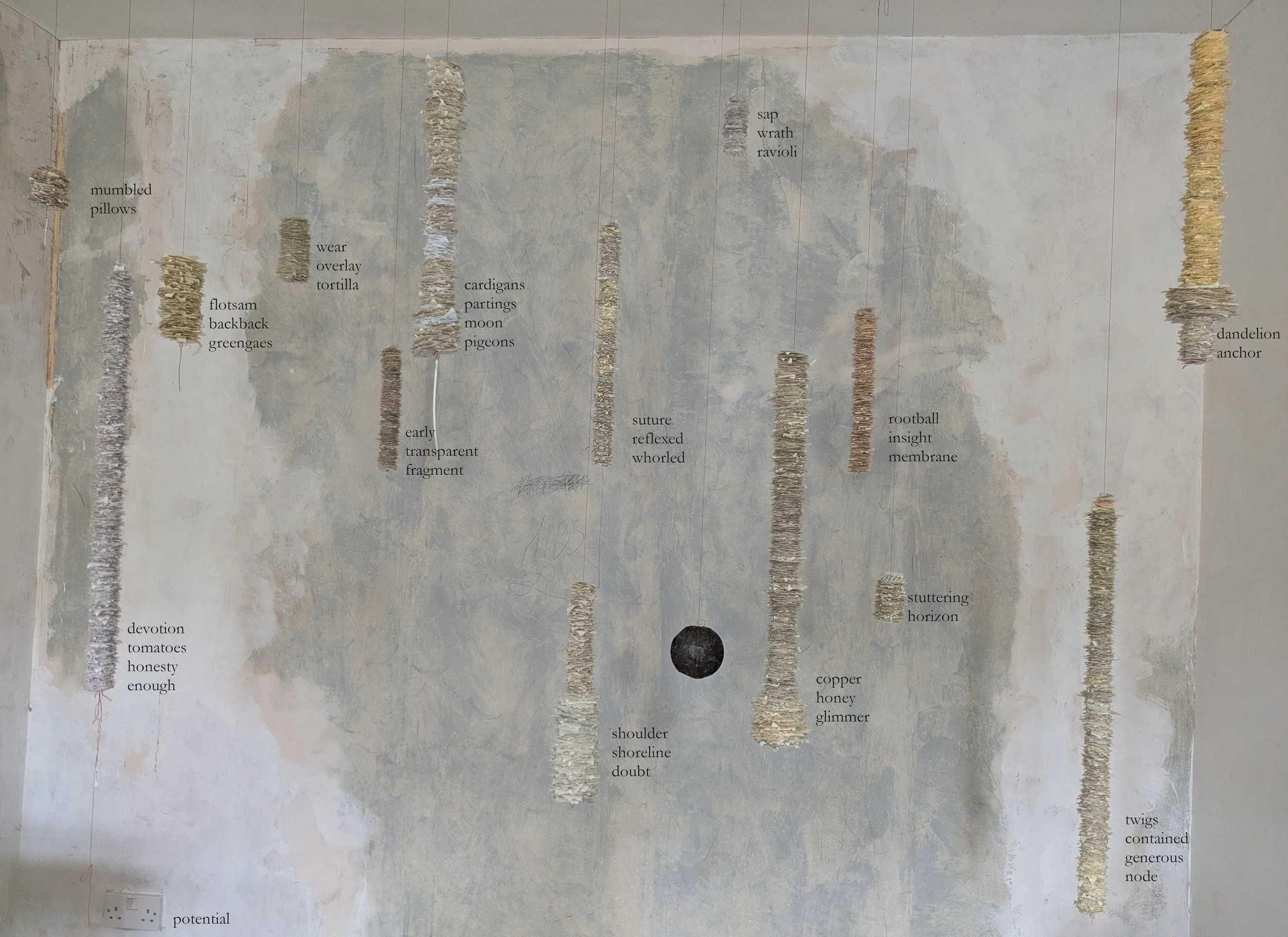
“I was told once that our thoughts contribute to the pollution in water - not in a materially visible way but maybe structurally altering its capacity for vitality. I have notebooks with decades of thinking, questioning, quotes and longings. The words that still resonate I have kept for further processing, but the rest I have torn and rethreaded and hung to air. They will all be composted one day, either directly or burnt and added as ash. Some words stood out in the shredding, forming a kind of condensation from the stream of consciousness over decades.
This is a work in progress but a photograph has the ability to extend a glimpse; gifting the possibility for a more durational dialogue with a moment; a form of punctuation in life’s sentence.”
Selby McCreery’s practice is one of noticing and drawing attention: “I use primarily words, photography and installation to explore consciousness and existence. Tracking the emergent beauty in the everyday, I condense these experiences into poetic participatory spaces and material to nourish and inspire others, I hope, to cherish life.”
CARBON BODIES (PART 2)
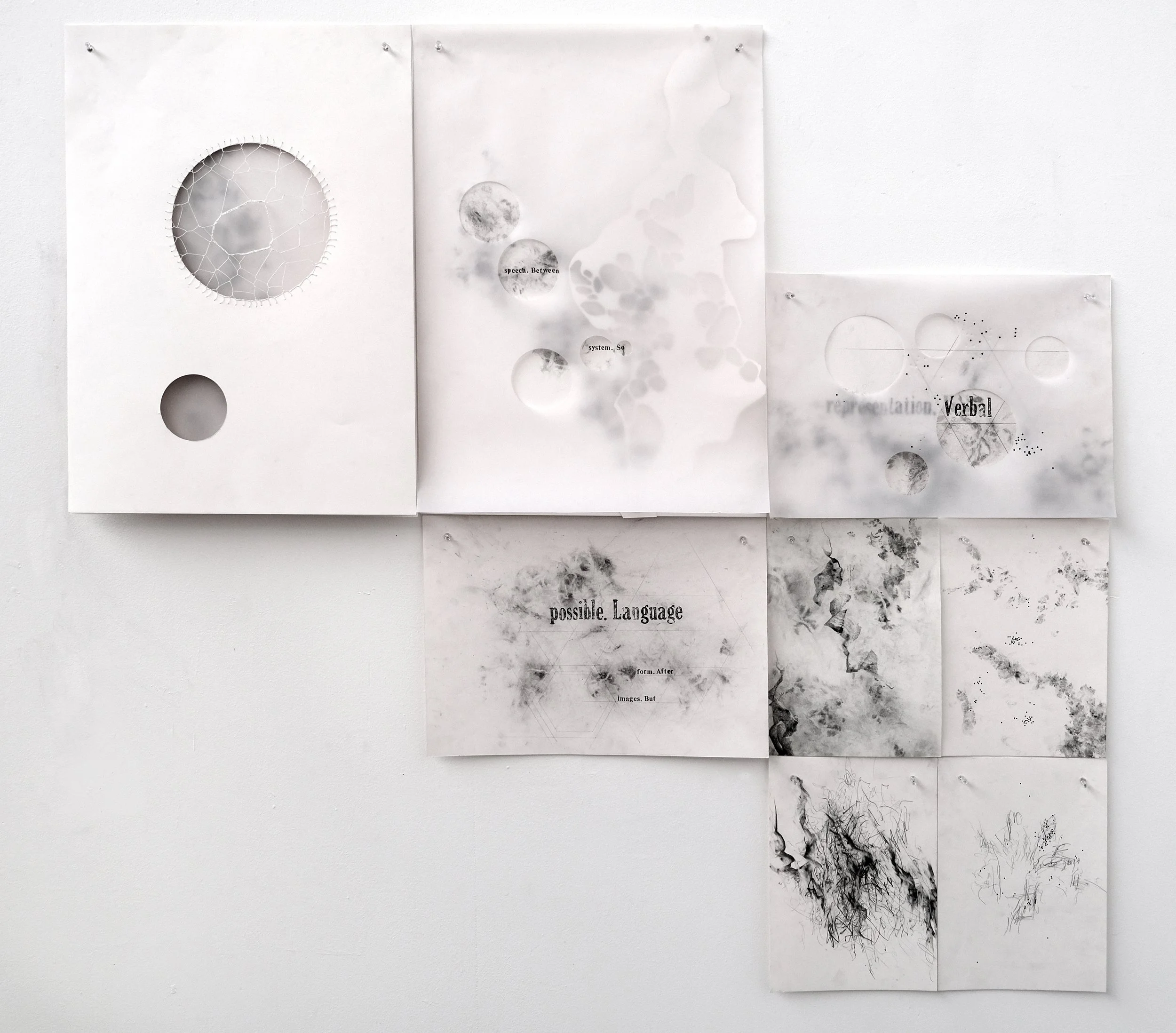
CARBON BODIES is an investigation of a bodily response to and in language. An expanding grammar of graphite marks, traces, blobs. These are the somatic event of the as–yet–unexpressed. The mouth opens and closes but nothing is uttered […] words fail. Watch for the bodily glitch as internal and external processes [mis]align. As my work retreats from textuality, the full stops are untethered from language, leaving them pointing at potential locations which remain incoherent. Fragments from these drawings have formed the basis of an artist’s pamphlet of the same title published by No Press, Canada, 2025.
Rachel Smith is an artist and visual poet, works across drawing, writing and printmaking, to produce artist books. Her hybrid practice flies through existing texts, embracing association, error, distraction, and a meandering lostness to explore how sense might be sought, rejected, and re-fused for this neuro-queer reader.
a failed marriage
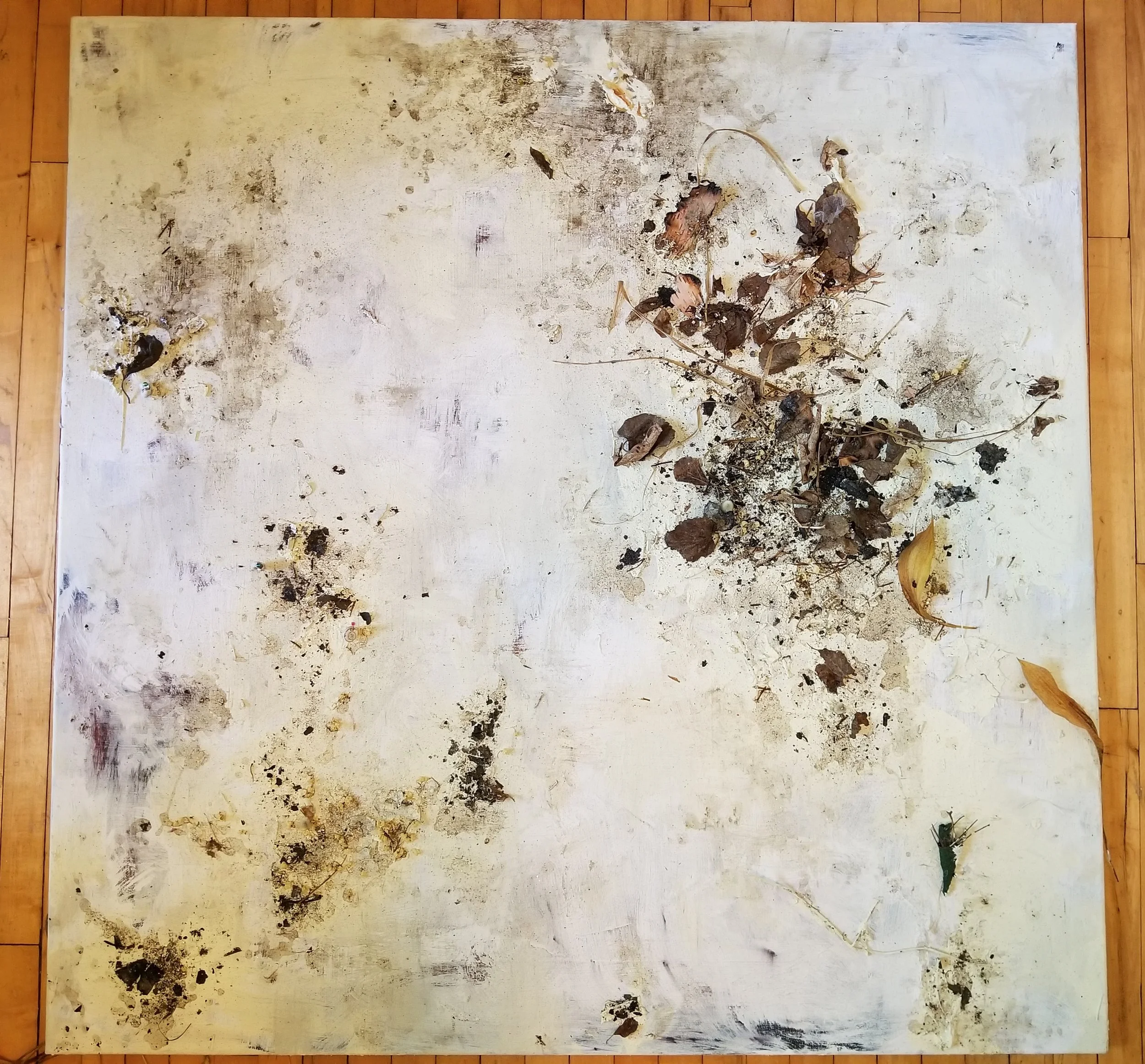
Created on a canvas that was salvaged from the curb on garbage day many years ago and then sat in the basement of my marital home before, during, and after my marriage ending (in 2020), this work layers years of experience and material from my wedding, my (failed) marriage, and the marital home that I am still living in but seeking to leave.
Materials: acrylic, house paint, soil, organic matter, dried flowers, leaves, ashes, snail shells, sewing pins, wedding boutonnier, smashed costume jewellery necklace, on reclaimed canvas, 36” x 36”.
Jessica Marion Barr is an artist, educator, and single mother whose interdisciplinary practice incorporates artmaking and research-creation, investigating collaborative, queer, embodied, and Indigenous-led approaches to environmental and social/ecological issues. An Assistant Professor at Trent University (Ontario), Jessica has exhibited artwork across Canada, and has attended trainings and artist residencies nationally and internationally.
Celandine 1
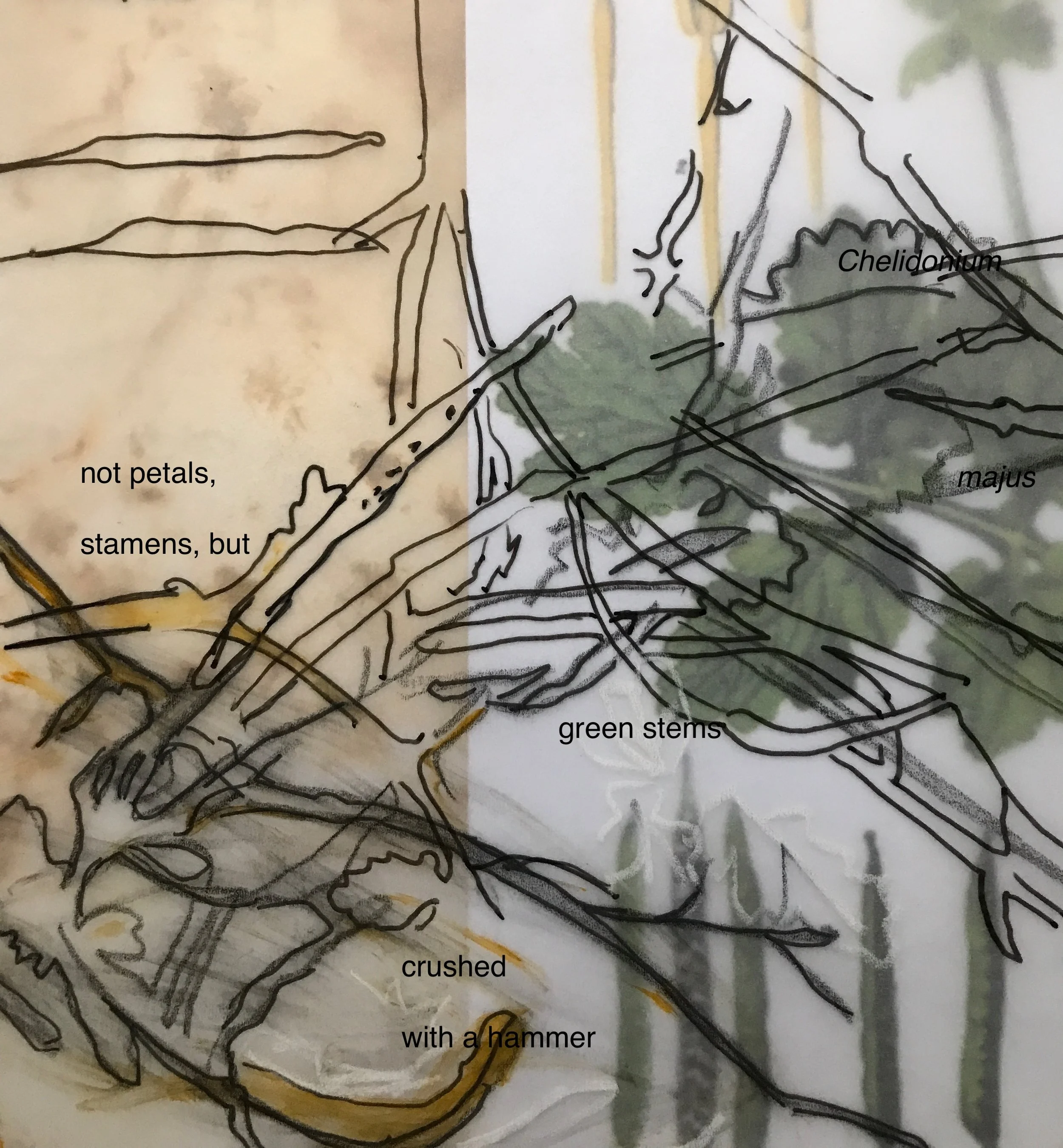
Behind the layers of different kinds of line -- constructed manually, digitally and photographically -- is a wash of yellow, an application of juice from flower-stalks of Chelidonium majus, the greater celandine.
Anna Reckin has published two collections of poetry with Shearsman, Three Reds (2011) and Line to Curve (2018). Her poems, essays and reviews have appeared in Long Poem Magazine, drain and Chants de la Sirène. Her chapbook Lavender and other colours is included in Intergraphia Series Four (2025).
www.annareckin.com
scrolls
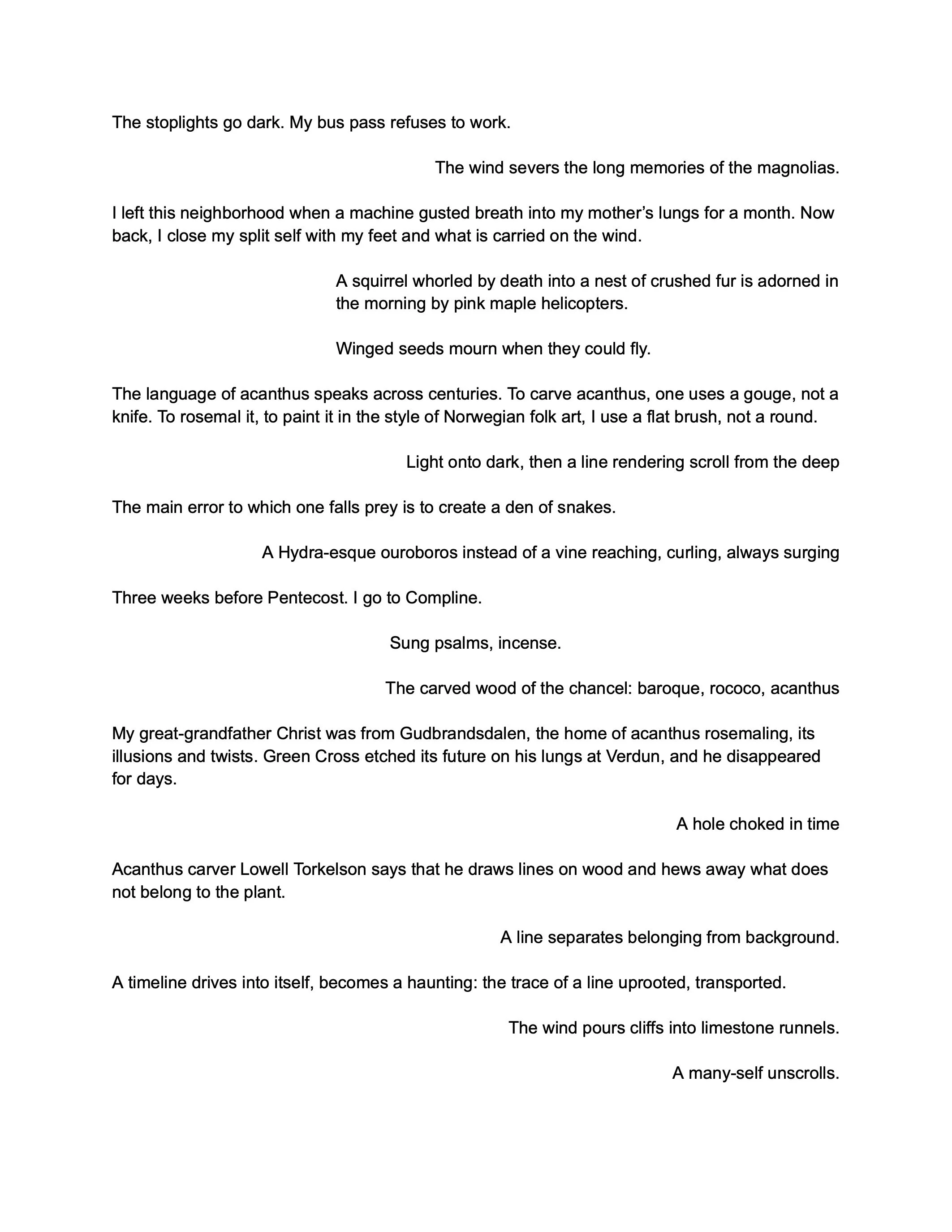
SCROLLS is a poem about heritage, memory, returns, and the language of acanthus carving and painting that communicates across centuries, cultures, and geographies.
Materials: writing.
Natalie Vestin is a Minnesotan writer, artist, rosemaler, and infectious diseases researcher. Her work has been published in Pleiades, The Normal School, Prairie Schooner, and elsewhere.
at the graveyard of discarded gateposts
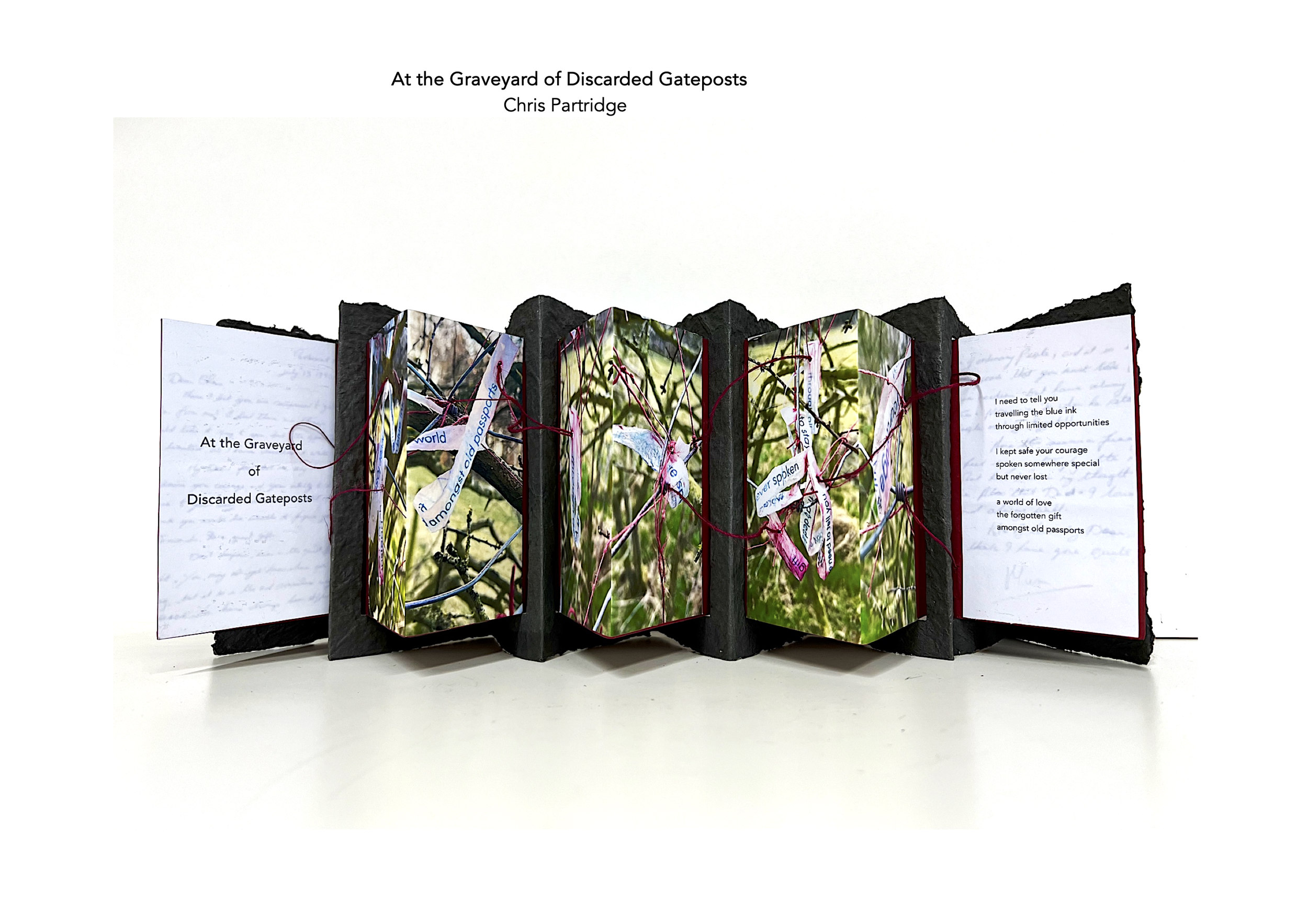
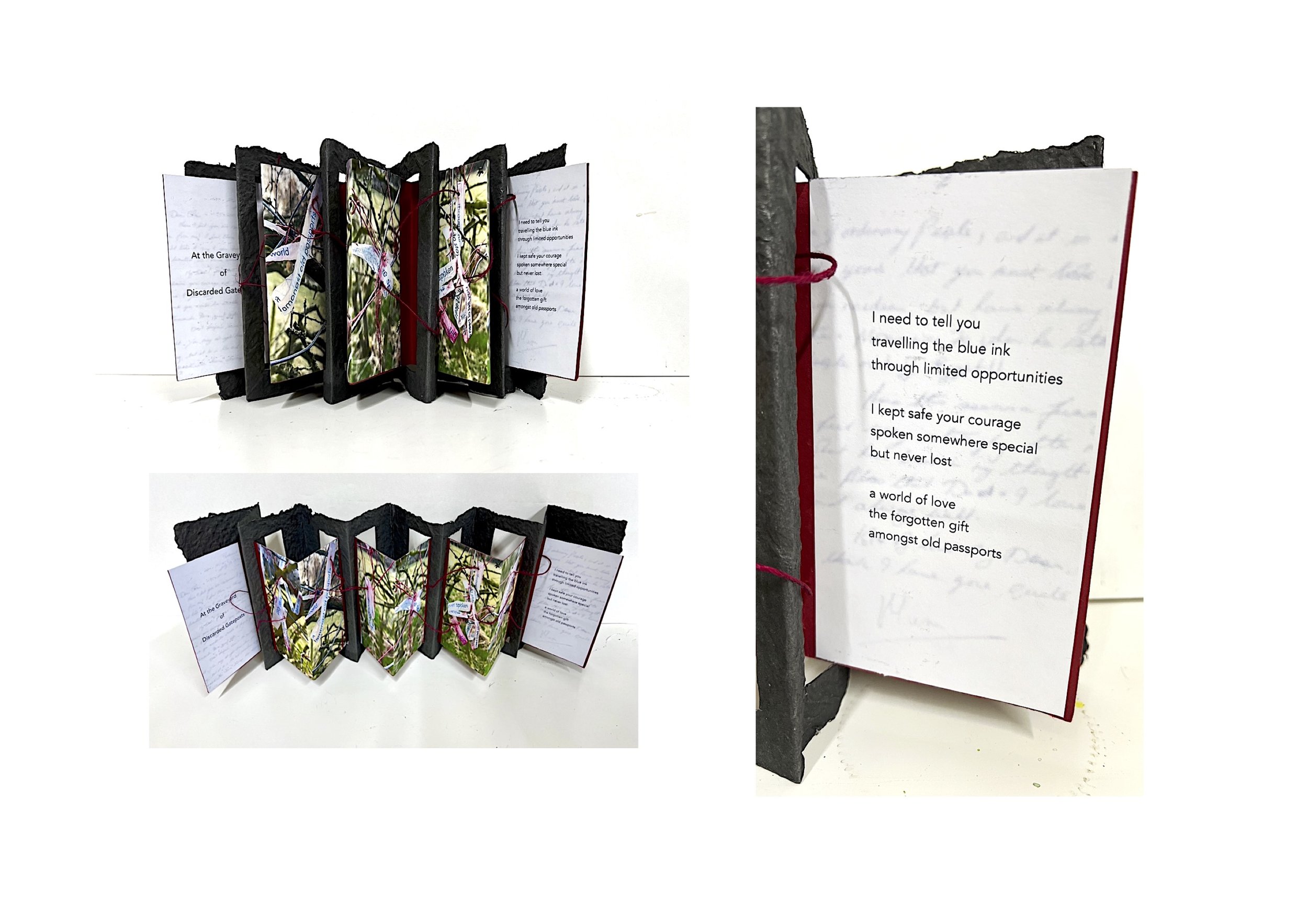
Chris Partridge is a visual artist and poet. Her place of thinking-through-doing is rural Northumberland, home to buzzard and badger. A place layered with of stories of ownership, extraction and re-wilding; where rusty wire becomes ‘bodies’ in the landscape, nettles are woven into string and poems become objects subject to continual transformation.
ROTATION / MIGRATION
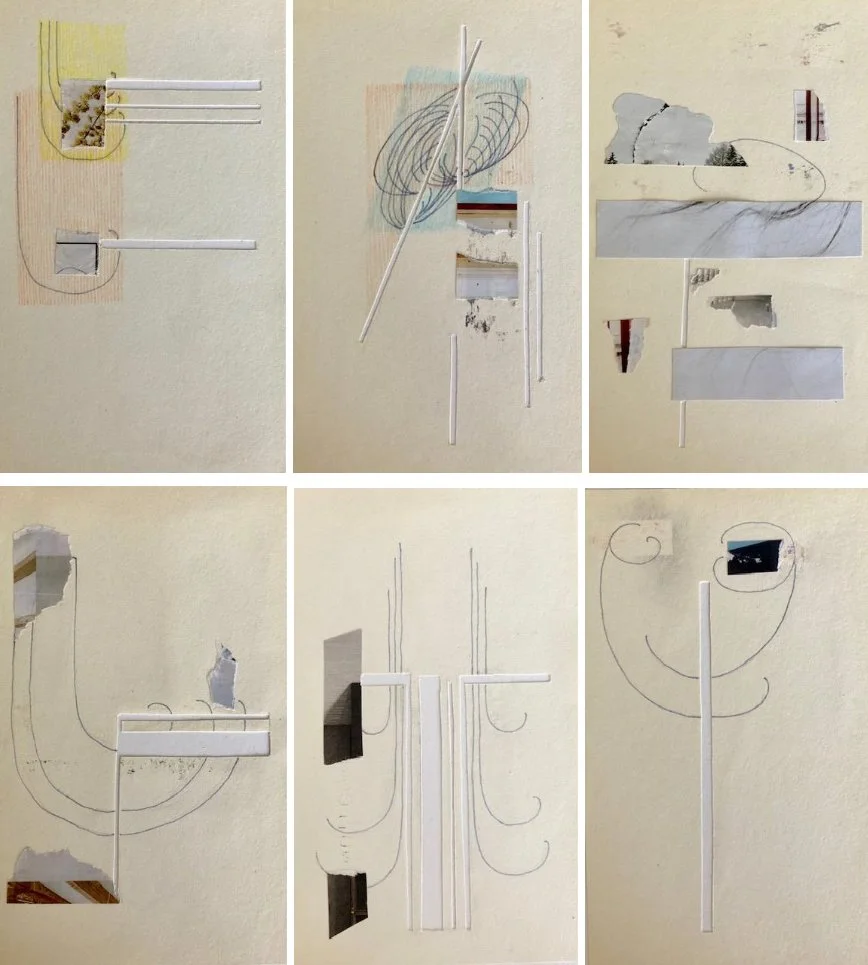
ROTATION / MIGRATION explores lines that tip things over, set them to rotate, or cause them to migrate: surface thunderstorms with their hot air moving up from the earth meeting a wind shear that knocks that air over and sometimes sets it spinning into a tornado; the rotation and migration of cells in the membranous epidermis; and the rotation of cells in a flower’s petals, which are expressing “petal” out of many possible expressions.
Materials: Collage, pencil, ink.
Natalie Vestin is a Minnesotan writer, artist, rosemaler, and infectious diseases researcher. Her work has been published in Pleiades, The Normal School, Prairie Schooner, and elsewhere.
the hidden library
Over nine days, Eules placed fourteen blank, folded booklets in hidden spaces like tree hollows, compost heaps, and dreamy spots was intuitive, without a scientific purpose. The images document insect inscriptions, snails and slugs clinging to the script, the coloration caused by berries, decay and substance change, the smell and stink of earth, the miracle of entangled fungal mycelia and plant networks.
Materials: cold press Fabriano aquarelle white fine 300g/m2, ca. 7 x 9 cm, garden raffia.
susanne eules is a German American transdisciplinary artist in the fields of experimental, visual, and sonic poetry, performance, and visual arts. www.susanneeules.net
BIBLIOGRAPHY
Ingold, T. (2016) Lines: A Brief History Oxford & New York: Routledge. Second Edition.
Ingold, T. (2015) The Life of Lines. Oxford & New York: Routledge. First Edition.
Torop, P. (2003) ‘Intersemiosis and Intersemiotic Translation’ in Petrilli, S. (ed.) Translation, Translation. New York: Rodopi.



TOWARDS AN EXPERIMENTAL ECOLOGY OF LINE
2024
The work on show here has been exclusively produced by participants from the 2024 Ecology of Line course. Over a period of six months (Feb-July 2024), a cohort of 18 artists, thinkers, writers and makers, moved through a creative-critical consideration of threads, dots, traces, combining these to form weaves, transcriptions, and finally coming together as an experimental ecology of line. This work has been divided into four sections to reflect these explorations:
TRACE
THE THREAD & THE WEAVE
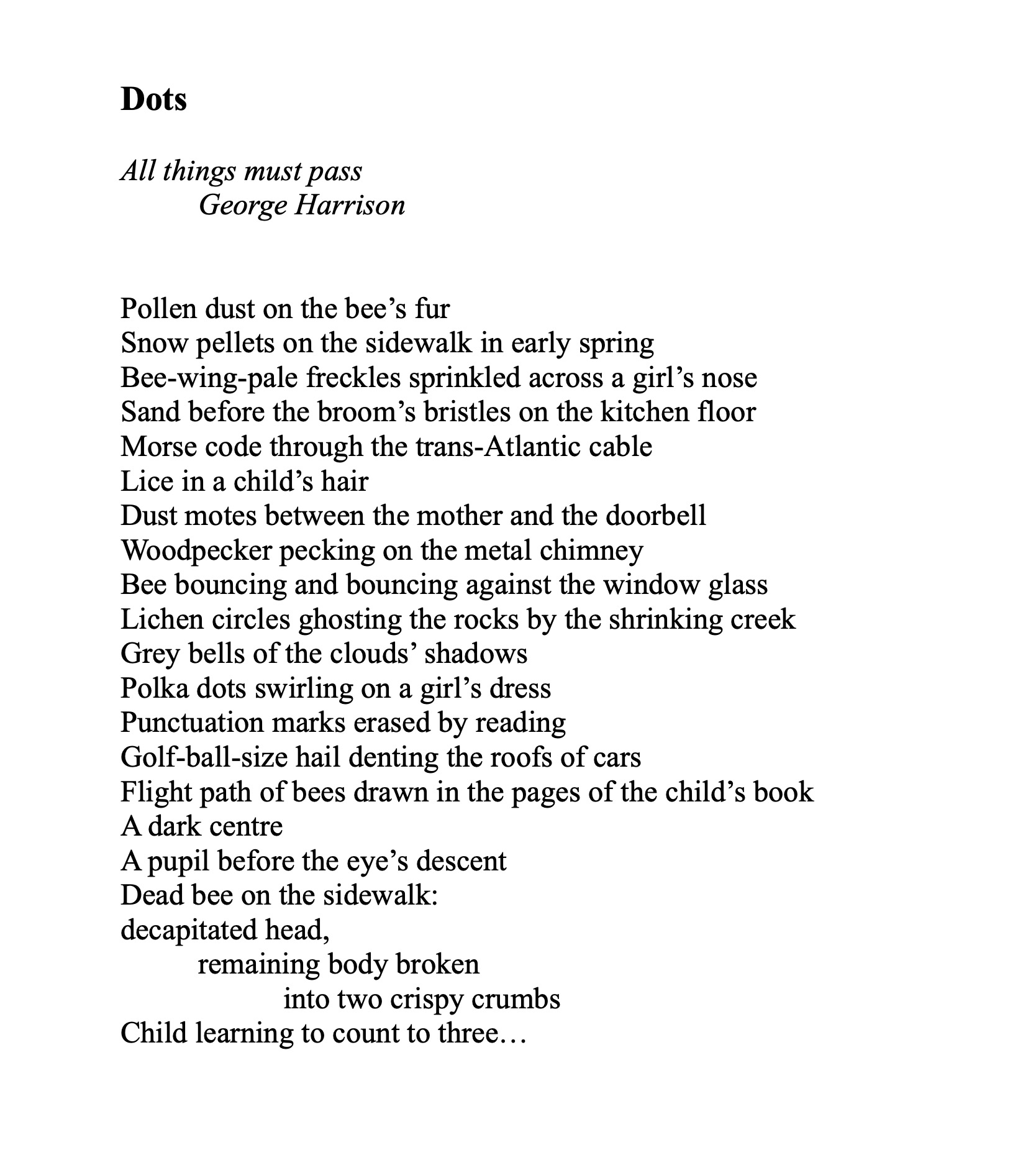
DOTS & BLOBS
TOWARDS AN ECOLOGY OF LINE
We hope you enjoy the show!
Camilla Nelson
Curator & Course Convenor

“Fireline” by Natalie Vestin
artists
SUSANNE EULES
NANCY HOLMES
NATALIE VESTIN
LINDA RUSSO
SARAH WESTCOTT
JENNIFER SPECTOR
PETRA KUPPERS
TESSA WAITE
TRACE
“Like threads, traces abound in the non-human world. They mostly result from the movement of animals, appearing as paths or tracks. The snail leaves an additive trace of slime, but animal tracks are usually reductive, caused by boring in wood or bark, imprinting in the soft surface of mud, sand or snow or, on harder ground, the wear and tear of many feet [...] The word writing originally referred to incisive trace-making of this kind. In Old English the term writing carried the specific meaning 'to incise runic letters in stone' (Howe 1992: 61)."
(Ingold, 2016: 44-46; my emphasis)
At the first point of contact between thread and surface a dot is created. If this contact is maintained, if the thread begins or continues to explore its relationship with surface, there forms a trace.
quabble
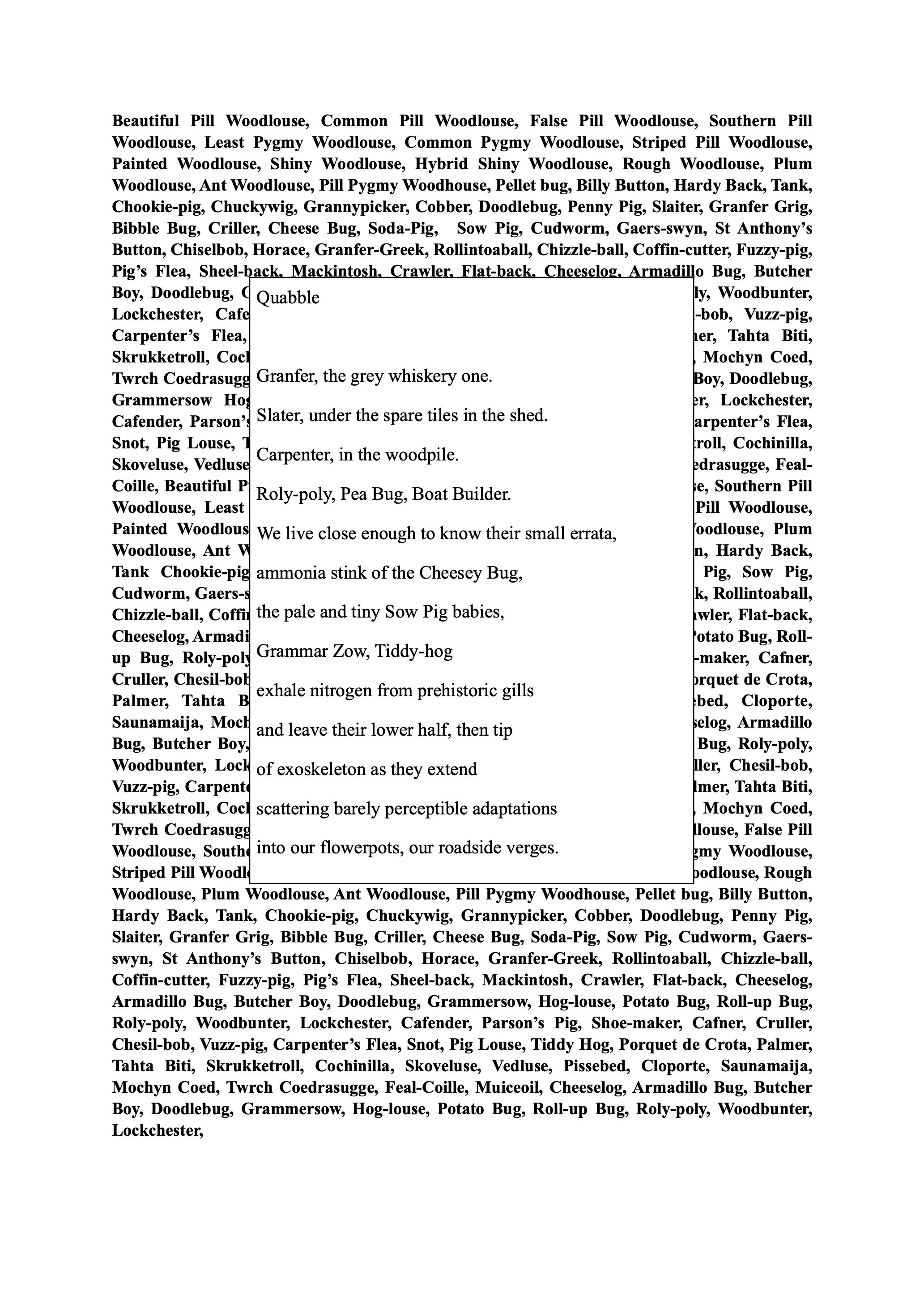
CAROL DALTON is a poet and therapist based in Kent, UK. Her work has been published online by Pamenar Press, Longbarrow Press and Datableedzine. She also has a piece in Litmus, the Lichen Edition.
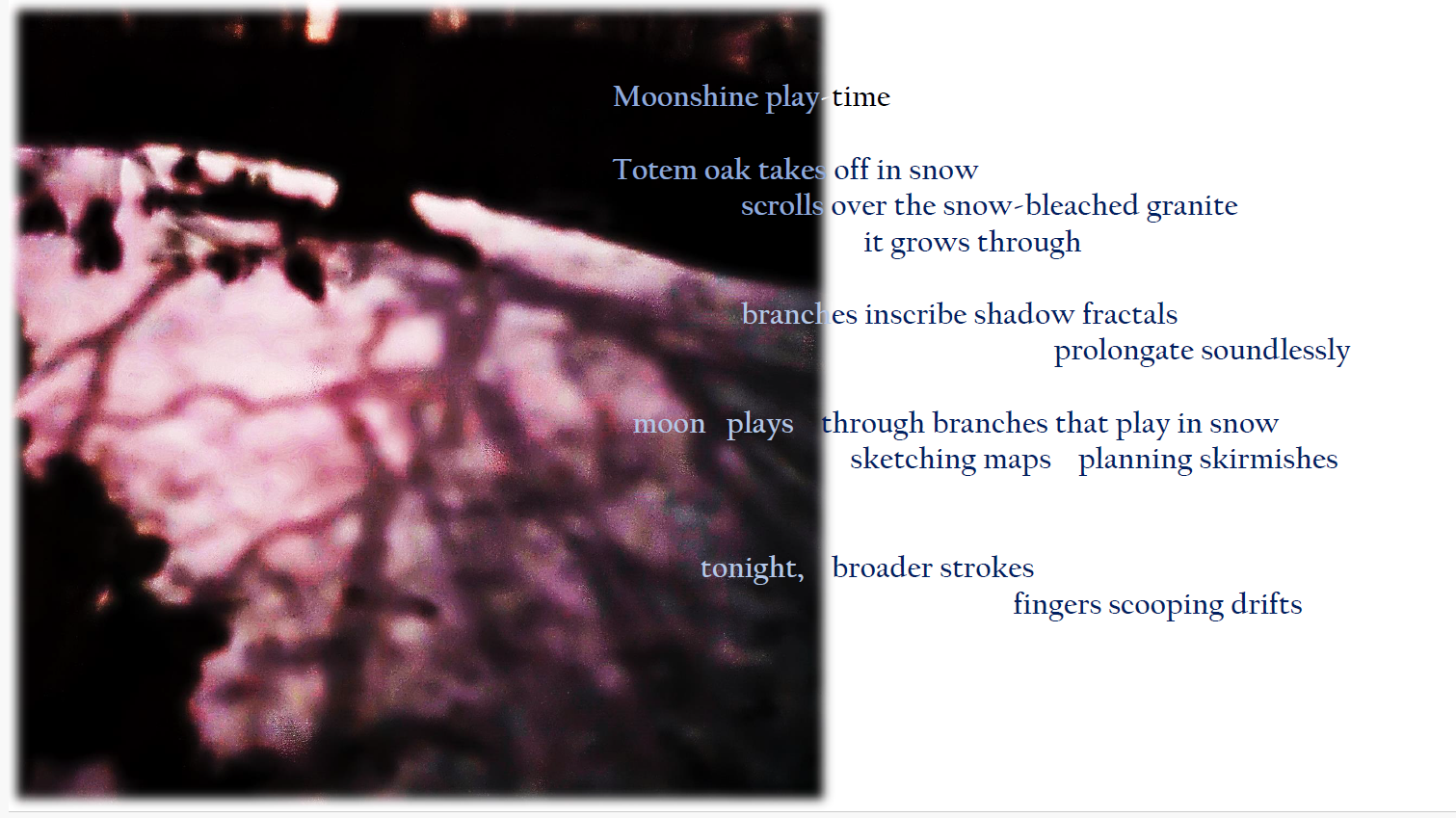
totm oak (2024)
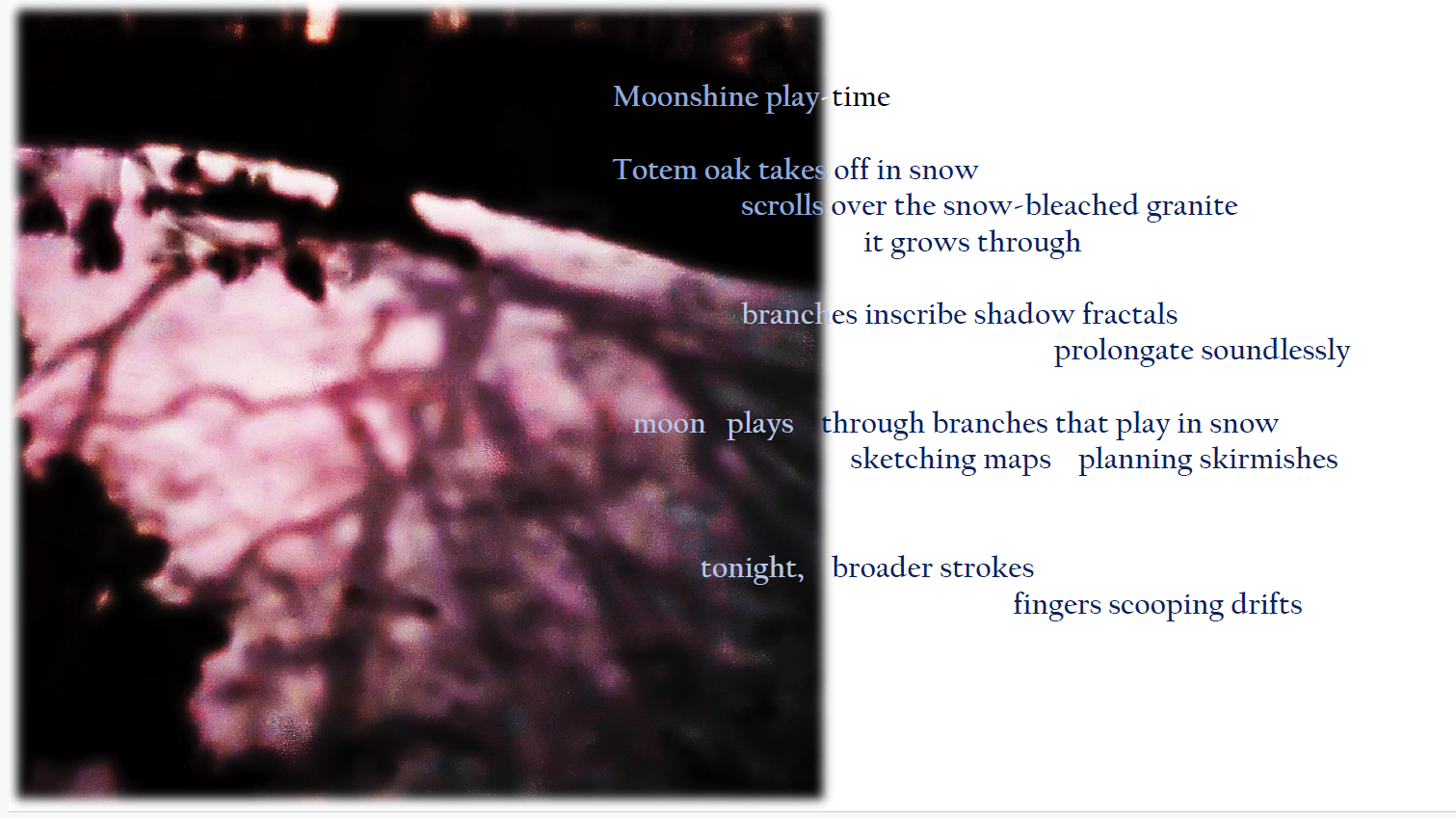
MARY NEWELL authored the poetry chapbooks TILT/ HOVER/ VEER (Codhill Press) and Re-SURGE (Trainwreck Press, now from the author), poems in numerous journals and anthologies, and essays including “When Poetry Rivers” (Interim journal 38.3). Her poetry book, ENTWINE, is forthcoming from BlazeVox Press. She is co-editor of Poetics for the More-than-Human-World: An Anthology of Poetry and Commentary and the Routledge Companion to Ecopoetics. Newell teaches creative writing and literature at the University of Connecticut, Stamford and intermittent online classes. Recording of a 2024 interview with the Brooklyn Rail.
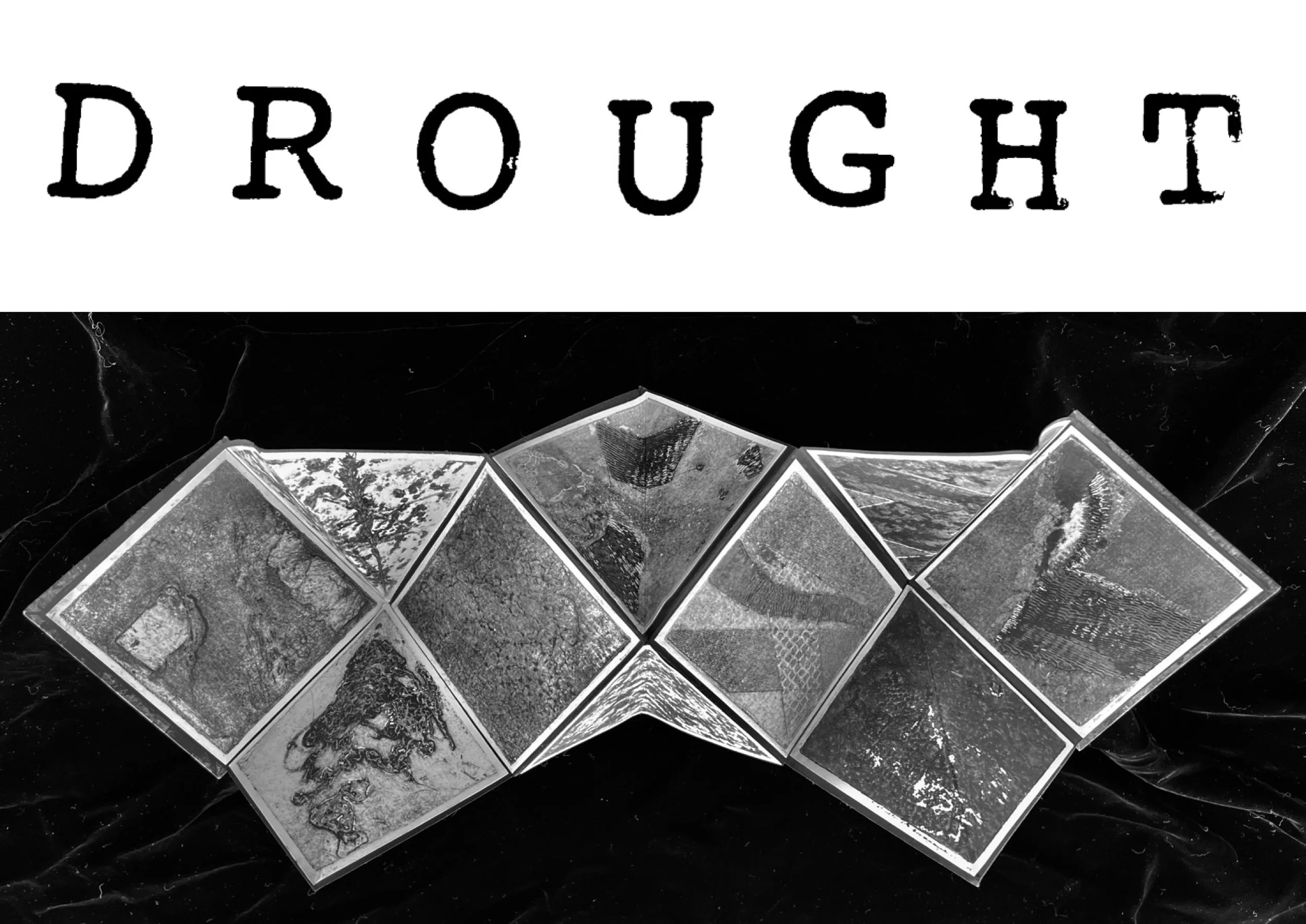
DROUGHT transcribes the drought-diminished landscape in Alberta, Canada, during the summer 2024 through a series of fine art prints bearing an uncanny resemblance to satellite imagery. Each of the five artist books (plus one artist proof), contains ten unique collagraph prints mounted in an “explosion book” format with handmade paste paper. See an essay on the project at: https://artthatmakesadifference.ca/drought-a-set-of-artist-books/.
BETH SHEPHERD is an Ottawa-based artist working in printmaking, photography, video, sculpture, and text. Situated at the intersection of ecology, animal advocacy, and ecocritical art history, her multi-year art-research projects explore the non-human world and humanity’s impacts on it. https://artthatmakesadifference.ca
the collectors

CHRIS PARTRIDGE is a visual artist and poet with a background in science, outdoor education and human development. Her creative practice is an on-going conversation with life, a dialogue about our entangled relationship with the natural world, impermanence and time. Multiple narratives that are ecological, historical, culture and economic. http://cpartist.co.uk/
BOUNDARY LAYER - A SCORE
Set out for a walk
Allow your intuition to guide you
Find a place where you can lie down on the ground
Lie down
Stay there for as long as you want
Give yourself time
Notice the sensations in your body and in your environment and where your thoughts take you
When you are ready, get up and walk away
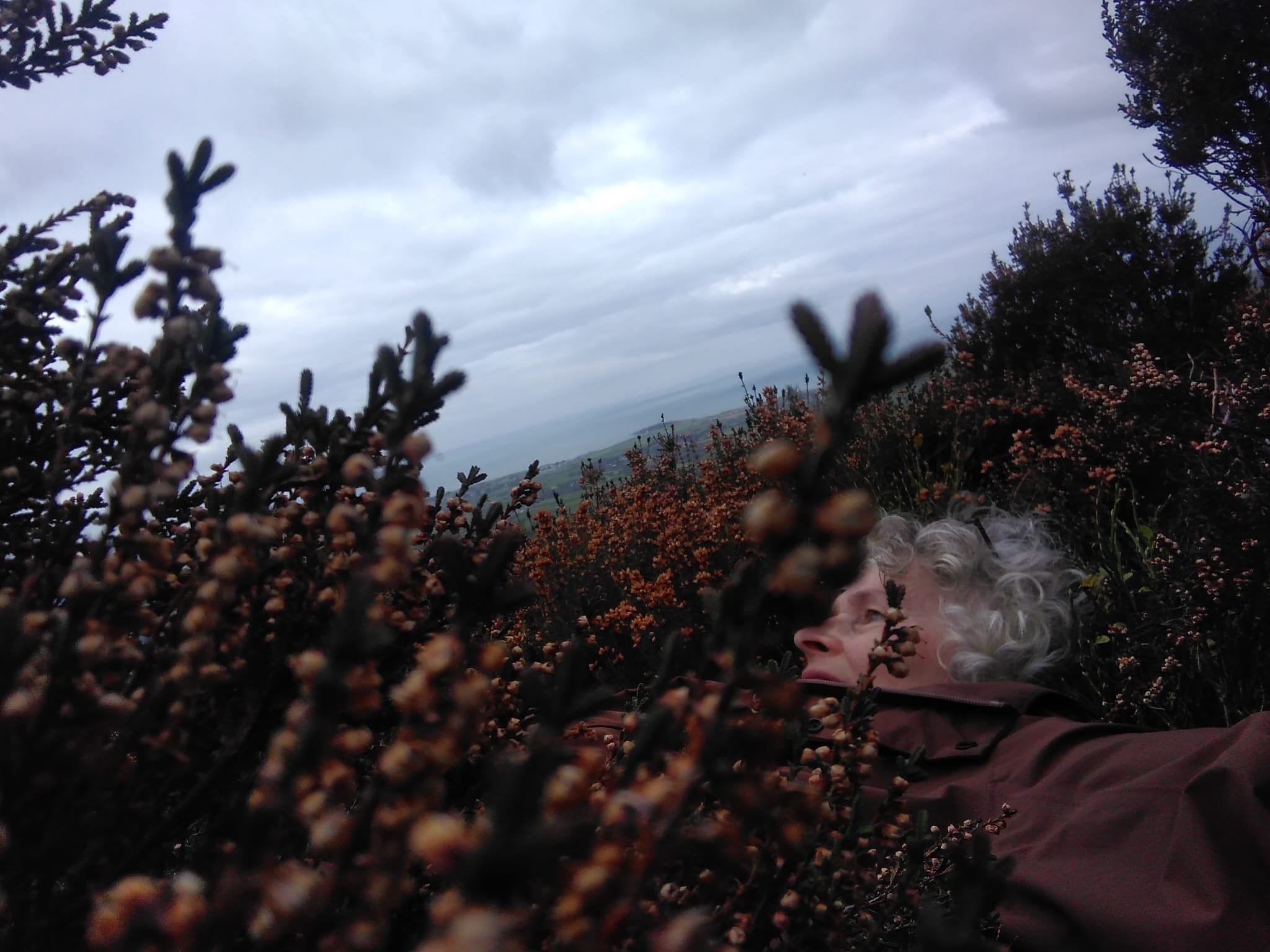
Based in Bannau Brychieniog, Mid Wales, TESSA WAITE has embarked on a daily act of lying down on the ground. “I often experience this as relief, to be literally grounded is to experience relief from my brain being at the top of my body. Once on the ground, body and brain are more equal. It opens me up to my imagination and what it means to be human and to connect in the broadest sense across a global surface to other lives who share it. In this way the practice I am developing focuses on a recognition of interconnectedness. This is in contrast to a pervasive sense of separateness and individualism, caused by the influence of capitalism and the dominance of technology. I use my being much like a tuning fork, translating these acts into images, words and live art performance. As a French horn player once said to me “it’s just air in and air out, with hopefully transformation on the way…”.
THE THREAD & THE WEAVE
“A thread is a filament of some kind, which may be entangled with other threads or suspended between points in three-dimensional space. At a relatively microscopic level threads have surfaces; however they are not drawn on surfaces.”
(Ingold, 2016: 42)
UNFOLDING THE COSMOS IN THE SELF


UNFOLDING THE COSMOS IN THE SELF (2024) draws on Daoist philosophy to explore the interconnectedness of all things, impermanence, and the cosmic flow of Qi through cyanotype on Xuan paper. Shadows of hair form patterns reminiscent of the cosmic web. This piece moves between order and chaos, embodying the transient nature of existence. The delicate paper sways gently in the air, creating shifting light and shadows, echoing the Daoist concept of flow and transformation. It unfolds as a quiet reminder of how the universe and the self are deeply intertwined in a constant state of flux.
Dimensions: 7.3m x 0.68m, 8.5m x 0.68m, 8.5m x 0.68m
Medium: Cyanotype on Xuan paper
BOYA LIANG is an artist exploring existence, time, and the essence of being through the intersection of art, science, and philosophy. Rooted in her Chinese heritage and cultural nomadism, her work seeks to articulate life’s fluid nature and the invisible connections between individual existence and the cosmos.
in the woven

In the woven
for Ken
tapestry of siblings, you asked,
you asked your body be dispersed
from the overlook of the glacial lake
where you loved to hike.
And so I find myself
on our last trip together
facing backward
on the train shuttling us forward
you next to me/not next to me
only the box with your cremains.
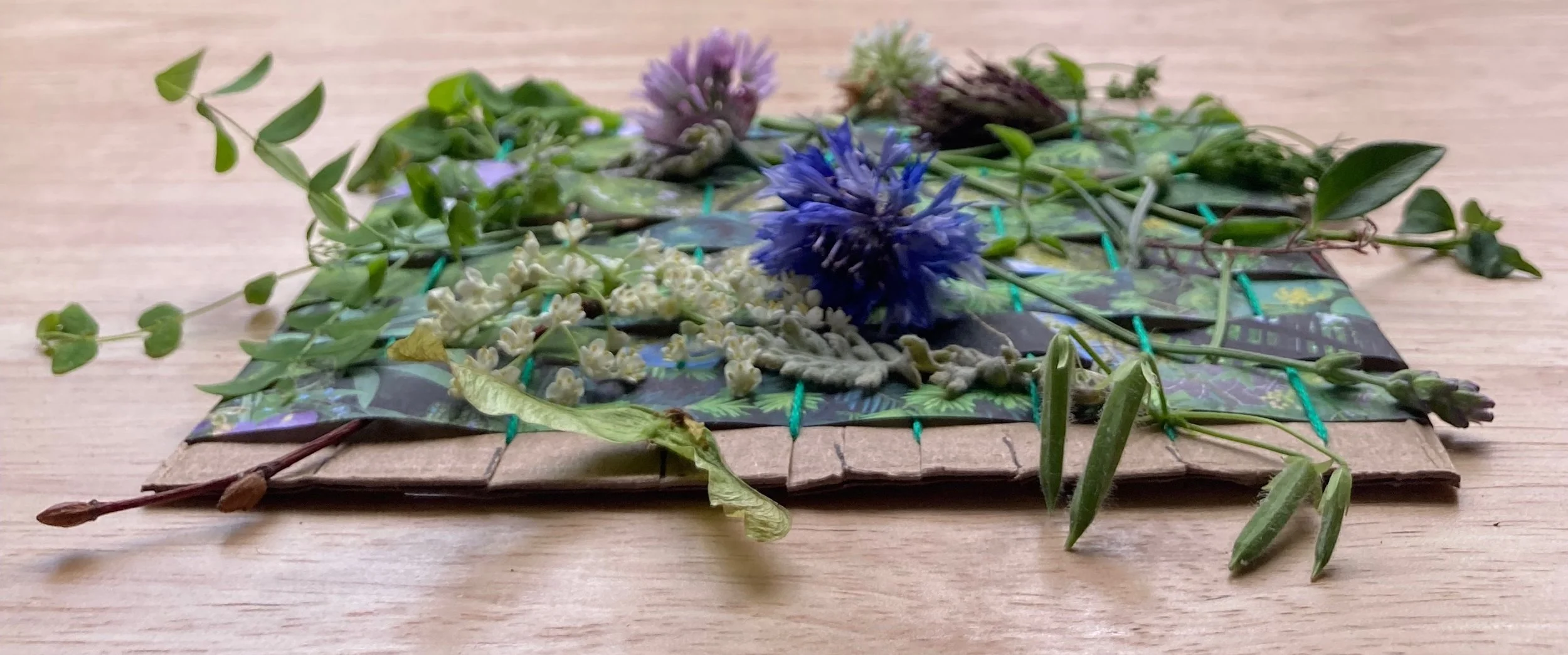
KAREN NEUBERG is the author of the full-length poetry collection, PURSUIT (Kelsay Press) and three chapbooks including “the elephants are asking” (Glass Lyre). Her poems and collages have appeared in numerous literary journals. She holds an MFA from the New School and is the associate editor of the poetry journal First Literary Review-East.
x/i:mport (the woven self)

x/i:mport (the woven self), 5 water colored paper stripes, 6,5 x 120 cm, calligraphy pen, 2024.
After 22 and 47 years, respectively, in the USA we moved to Germany two years ago, facing practical, mental, and emotional issues of preparing, leaving, letting go, arriving, building anew from scratch for the second time. Transcribing a list of short comments regarding questions of missing (yellow), not missing (grey), of wanting to (blue)/must do (red), awareness of doing the last time (green) into a paper sculpture, I realized how all details of our lives are entangled with each other, embedded in different countries at the same time due to relationships, citizenship status, and the exchanging our house for a rental apartment.
SUSANNE EULES is a German American transdisciplinary artist in the fields of experimental, visual, and sonic poetry, performance, and visual arts. Recipient of the German Award for Nature Writing 2023 for miami t:ex[i]ting, published by Matthes & Seitz, Berlin 2025. nivolog was published by Contraband Modernist Poetry Press, UK in 2023.
THE FIRST CUT IS THE DEEPEST
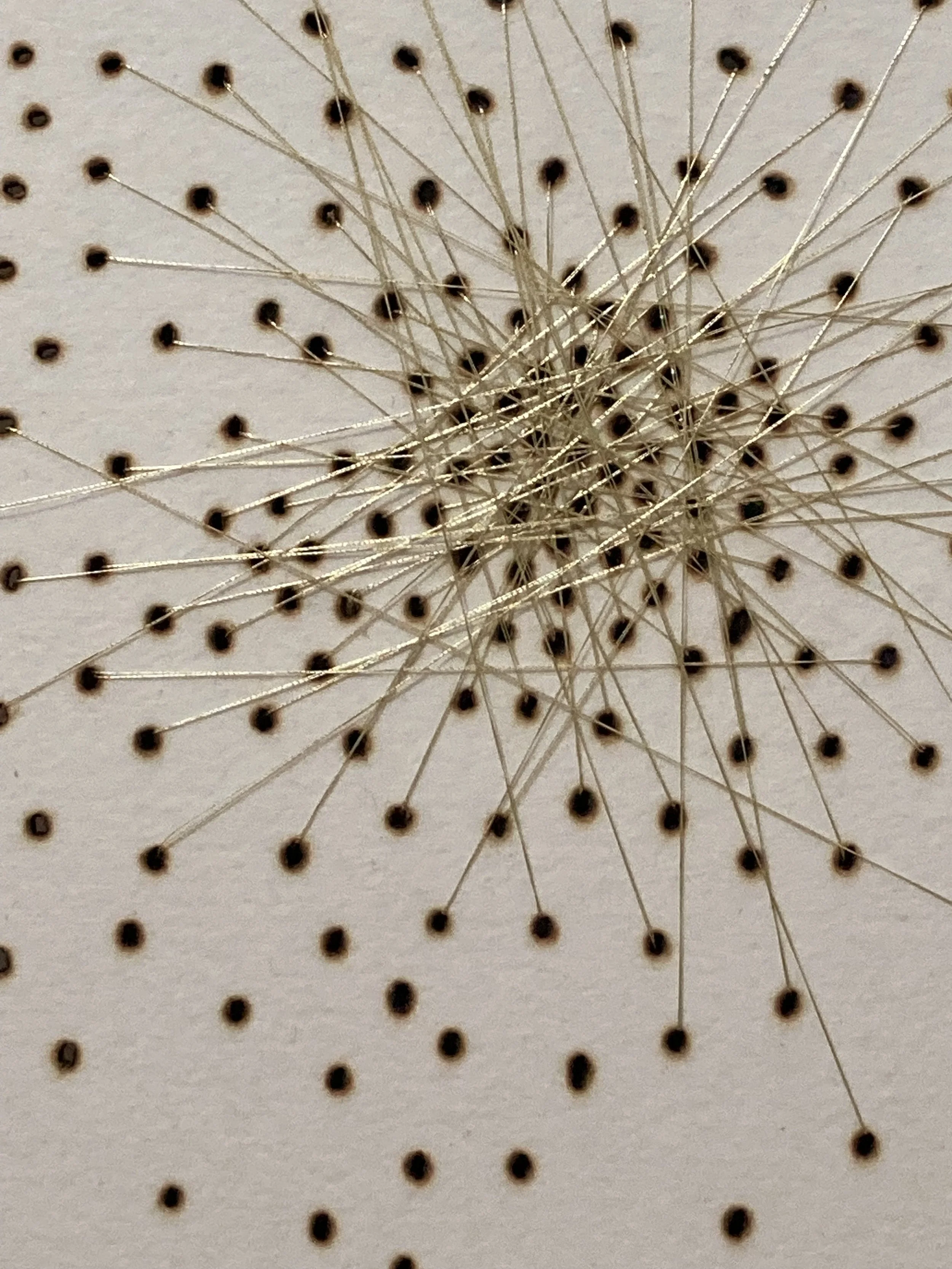
Handmade paper with holes burned into it. Vintage Japanese gold thread.